
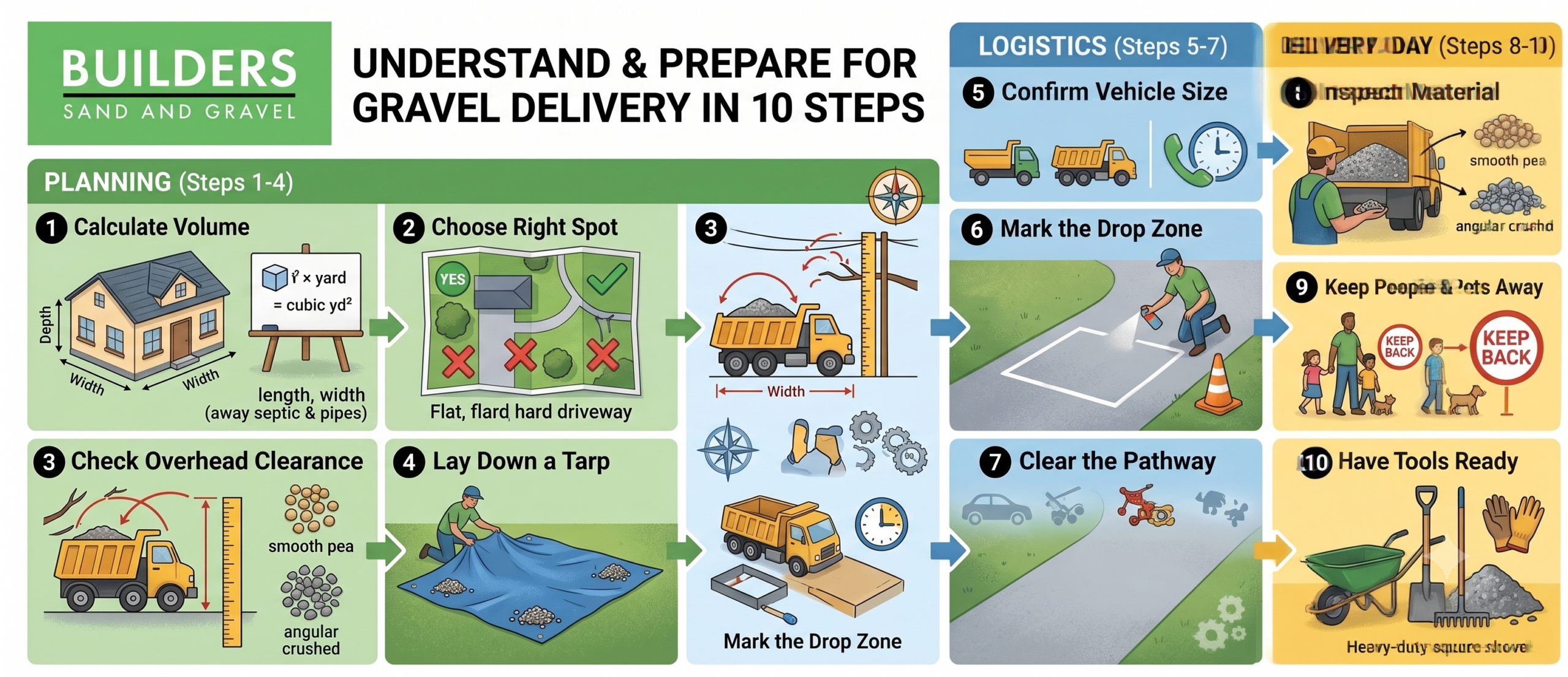
Understand & Prepare for Gravel Delivery in 10 Steps
Gravel is one of the most useful materials you can put down around a property. It builds driveways, lines pathways, improves drainage, and finishes a planting bed, all without pouring concrete or waiting on a crew. The one catch is weight: a single cubic yard runs about 2,700 pounds, so a smooth delivery comes down to knowing what to order and having the area ready before the truck pulls up. Below is the practical rundown we walk customers through most often when they call to order.
The 10 steps to prepare for your gravel delivery
Here is the short version of getting ready for the truck. The sections below go deeper on the material itself, but these are the steps that make delivery day go smoothly.
- Calculate volume. Measure length, width, and depth to work out how many cubic yards you need.
- Choose the right spot. Pick a flat, firm drop area, clear of the septic system and underground lines.
- Check overhead clearance. Make sure there is room for a raised dump bed, away from wires and branches.
- Lay down a tarp. Putting a tarp under the drop zone keeps the gravel clean and makes cleanup easy.
- Confirm vehicle size. Check that the delivery truck can reach the spot and turn around.
- Mark the drop zone. Flag exactly where you want the pile so the driver places it right the first time.
- Clear the pathway. Move cars, toys, and obstacles so the truck and your wheelbarrow have a clear route.
- Inspect the material. Confirm you are getting the right product, whether that is smooth pea gravel or angular crushed rock.
- Keep people and pets away. Keep kids and animals back from the truck and the drop zone during delivery.
- Have your tools ready. A wheelbarrow, a heavy-duty square shovel, and a rake make spreading the gravel far easier.
What gravel actually is
Gravel is small stone, roughly 1/8 inch to 3 inches across, used for pathways, driveways, and around plants to help water drain. Some of it is smooth and water-rounded, some is crushed so the edges are sharp and angular, and that difference is what makes one type right for a garden path and another right for a driveway. As a rough guide, a single cubic yard covers about 100 square feet at a depth of 3 inches.
The main types of gravel
Crushed gravel. This is the workhorse. It is made from crushed rock, comes in a range of sizes, and the angular edges lock together, which is why it is the usual pick for driveways and as a base under pavers.
Pea gravel. Small, round stone about the size of a pea. The smooth surface is comfortable underfoot, so it tends to go down on pathways, play areas, and around plantings rather than under traffic.
What size you should use
The right size comes down to the job. For a pathway you want smaller stone that is easy and comfortable to walk on. For a driveway you want something larger and more durable that holds up under the weight of vehicles. Think about the purpose first and the load it has to carry, and the size mostly sorts itself out.
How much you need
This is the question we field most. It depends on the area you are covering and how deep you want the gravel to sit. Work out your square footage, decide on a depth, and then order a little more than the math says to allow for calculation errors and the obstacles you will not notice until you start. The table below gives a quick reference for common materials and where they fit.
| Type | Typical size | Common use |
|---|---|---|
| Pea gravel | about 3/8 inch | Paths, play areas, plantings |
| 5/8 inch minus | 5/8 inch and down | Driveways and paver base |
| Crushed drain rock | about 1 1/2 inch | Drainage and dry wells |
| 2 inch minus | 2 inch and down | Heavy-use base layer |
Keep the weight in mind too. At roughly 2,700 pounds per cubic yard, you need a plan for moving and spreading the gravel once it is delivered. If you tell us your square footage, we are happy to help you figure the yardage.
A quick example: a 200-square-foot driveway at 3 inches deep needs about 2 cubic yards of gravel, and a 100-square-foot garden path at 2 inches deep needs roughly 1 cubic yard. Order a little extra to cover settling and low spots.
Preparing the area
Good prep is what makes gravel last. Start by clearing any grass, weeds, or other vegetation and leveling the ground with a rake or shovel. For a driveway or another heavy-use area, dig down and lay a compacted base of crushed stone first so the surface has something solid to sit on. Drainage matters as much as the base, so build in a slope or a simple drainage system (a coarse drain rock works well here) to keep water moving away rather than pooling under the gravel.
Installing it
Once the area is ready, move the gravel from the truck with a wheelbarrow or a heavy-duty cart, then spread it evenly with a rake, working out any piles or low spots as you go. Uneven gravel is both a tripping hazard and a drainage problem, so take the time to level it. When it is spread, compact it with a hand tamper or a rented plate compactor so it stays put.
Maintaining it
Gravel is low maintenance, not no maintenance. Rake it now and then to keep it level, clear off debris as it collects, and top up any spots where the stone has thinned, sunk, or shifted over time. If a whole area starts sinking or going uneven, add fresh gravel and compact it more thoroughly.
Gravel or mulch?
Gravel around plants does help with drainage, but it is not a straight swap for mulch. Mulch retains moisture, suppresses weeds, and feeds the soil as it breaks down, none of which gravel does. Gravel also reflects heat, which can make a hot, sunny bed even hotter on the plants, so reach for it where drainage is the goal rather than as a blanket replacement.
Common questions
How do I choose a delivery dealer? Look for a supplier with a solid reputation and real customer reviews and testimonials. A dependable dealer makes the whole project easier from the first phone call.
How do I get started? Contact us about pricing and delivery options. Builders Sand & Gravel, Inc. is the premier crushed rock and driveway gravel supplier to Seattle, Bellevue, and Snohomish County. Our crushed rock is a blue-gray basalt, and we also carry crushed ledge rock, 5/8 inch clean, 5/8 inch chips, type 22, 3/4 inch chip, 1 inch clean, 1 1/2 inch crushed drain rock, crusher run, 2 inch minus, 4 to 8 inch, permeable base rock, and permeable top course. We deliver other colors as well, so call for details.
Tell us your project and square footage and we will help you figure the yardage. We deliver crushed rock and driveway gravel across Seattle, Bellevue, and Snohomish County. Contact Builders Sand & Gravel for a delivery quote.