
Landscape Rock Sizes: How to Choose the Right One for Your Project
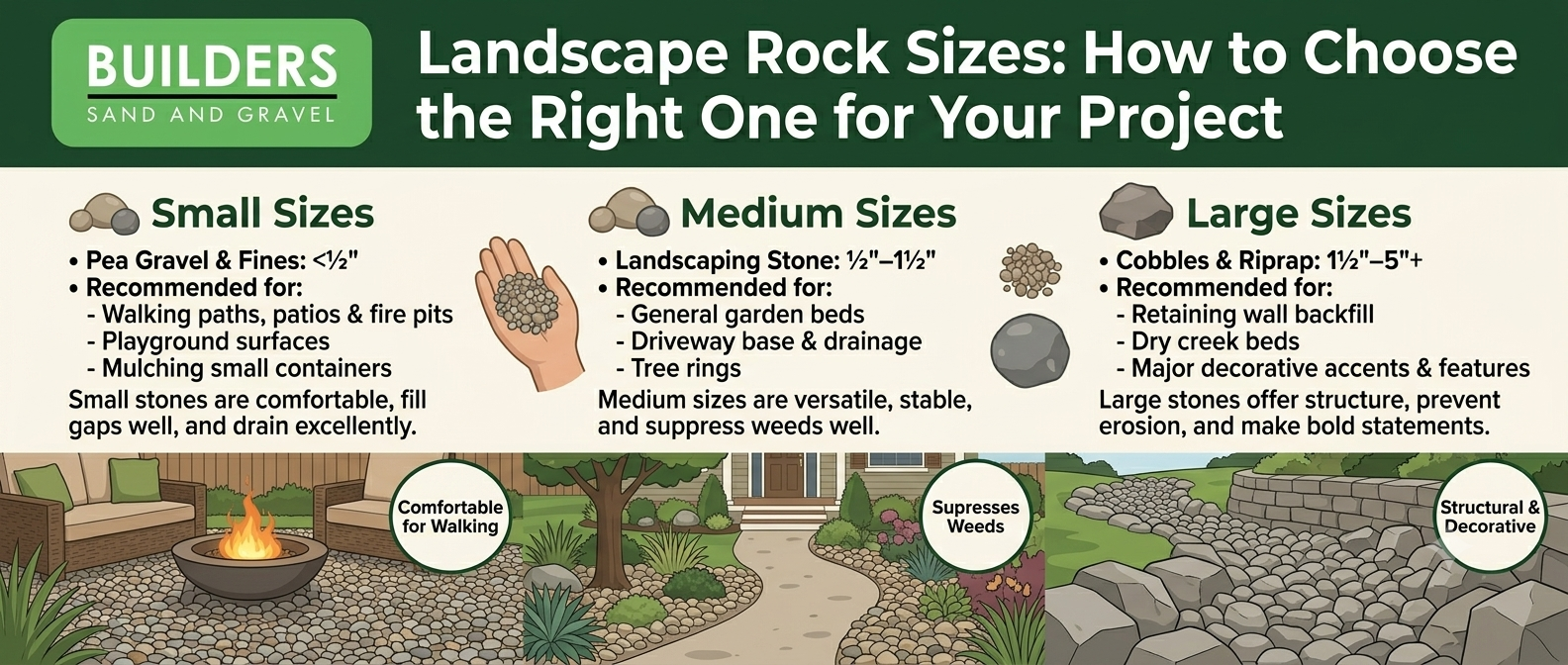
Picking landscape rock is less about looks and more about size. The same project can succeed or turn into a maintenance headache depending on whether the stone is too big to rake level or too small to stay put. After years of taking orders, the question we hear most is some version of “what size do I actually need?” Below is how we talk customers through it, from the smallest washed gravel up to boulders that take a machine to place.
Start with the job, not the rock
The fastest way to choose is to picture what the stone has to do. Will people walk on it? Does water need to move through it? (For drainage-heavy projects, Washington’s Department of Ecology Rain Garden Handbook is a helpful reference.) Is it holding soil back, or just dressing up a bed? Foot traffic and drainage push you toward smaller, rounded stone; structure and erosion control push you toward larger, angular rock. Once you know the job, the size almost picks itself.
A quick size guide
| Rock size | Roughly | Best for |
|---|---|---|
| Pea gravel | 3/8 inch, rounded | Paths, patios, fire pit surrounds, play areas |
| 5/8 inch minus crushed | 5/8 inch and smaller, with fines | Compacted base for patios, driveways, pavers |
| 3/4 to 2 inch river rock | 1–2 inches, smooth | Decorative beds, borders, dry creek beds |
| 2 to 4 inch quarry spalls | Baseball-sized, angular | Small retaining walls, soft-ground stabilization |
| Boulders / landscape rock | Half-man up to 4–5 man | Focal points, large walls, outcroppings |
 |  |  |
Pea gravel (about 3/8 inch)3/8″
This is the small, water-rounded stone people choose when they want a comfortable, walkable surface without pouring concrete. Its rounded edges make it easy on bare feet and simple to rake level, which is why it shows up on patios, garden paths, and around fire pits. Because it stays loose, it needs edging to keep it contained. If a pea gravel project is what you’re planning, we go deep on coverage, cost, and how to install it in our pea gravel guide.
5/8 inch minus crushed gravel5/8″ minus
“Minus” means the load includes the dust and fines along with the stone, and that’s the point — those fines let it compact into a hard, stable surface. The sharper edges lock together under a plate compactor, which makes this the go-to base layer under patios, paver sets, and driveways. It’s a workhorse material rather than a decorative one; you usually don’t see it once the project is finished.
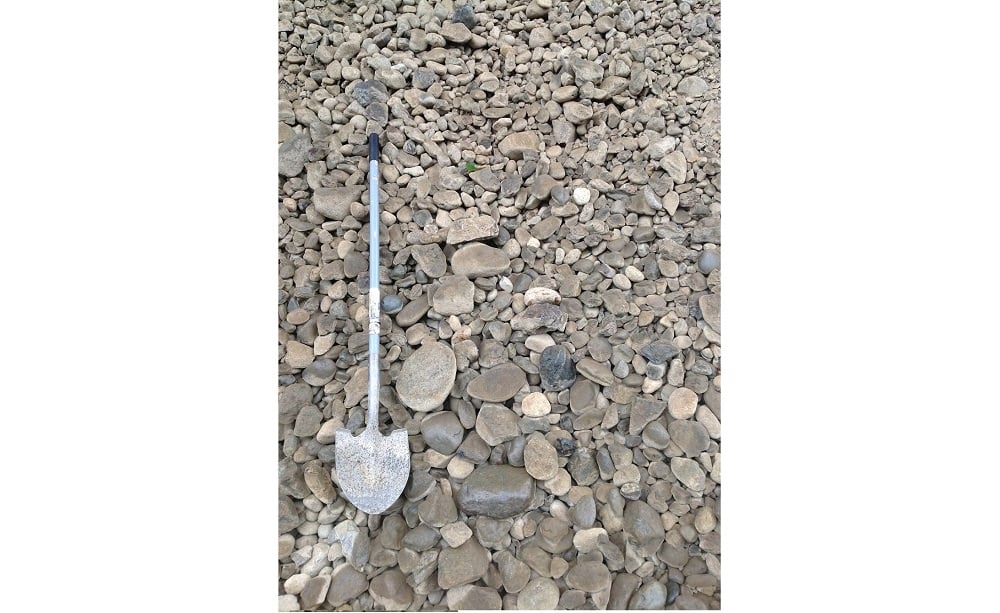
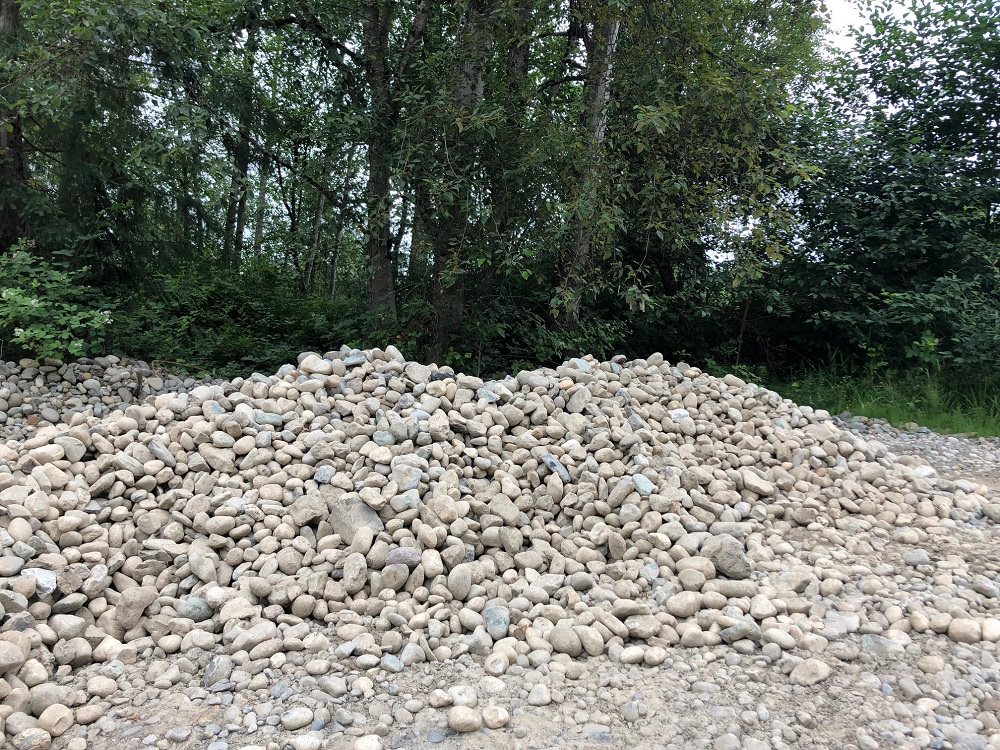
3/4 inch to 2 inch river rock3/4″–2″
River rock is smooth gravel, generally one to two inches across. It’s the decorative middle ground: big enough that it doesn’t scatter the way fine gravel does, smooth enough to look intentional in a bed or along a path. People use it to mulch flowerbeds, line walkways, and build dry creek beds. If you want something that reads as “finished landscaping” without a lot of fuss, this is usually the size.
2 to 4 inch quarry spalls2″–4″
These are the jagged, baseball-sized rocks you reach for when you need stability. They compact reasonably well while still letting water filter through, so they’re common in smaller retaining walls and as a firming layer in wet or soft ground before you build on top. They’re function over form — useful underfoot and behind the scenes rather than as a finish surface.
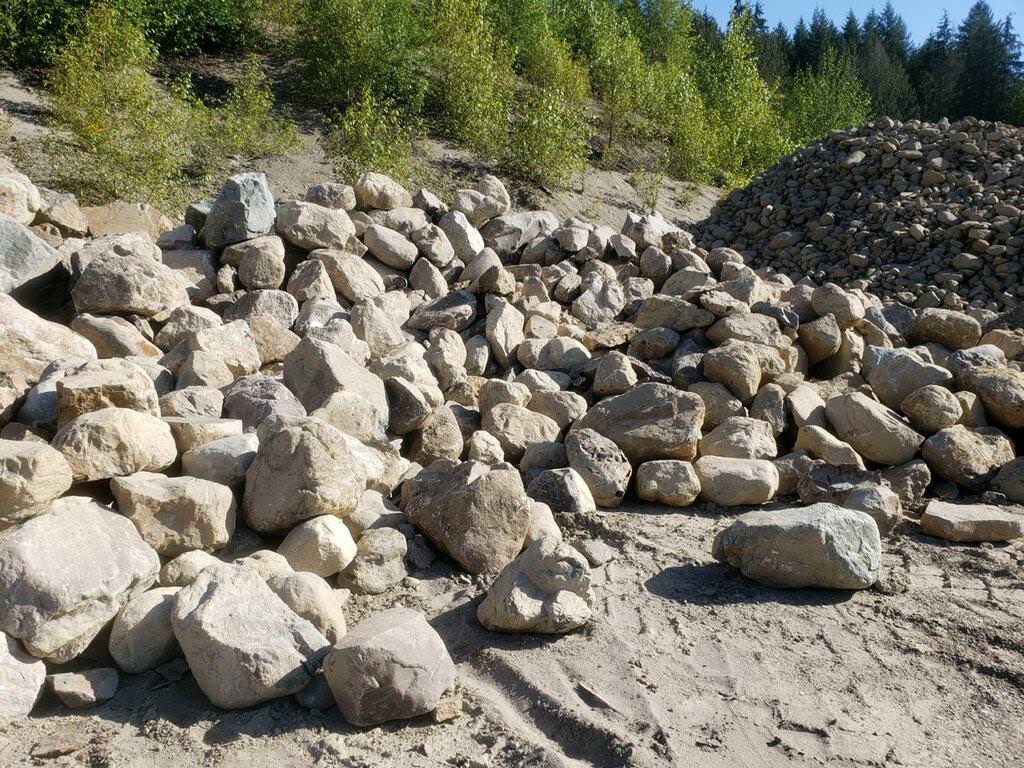
Large boulders and landscape rockBoulders
At the top end are the boulders, sized anywhere from half-man up to four- or five-man (the old yard shorthand for how many people it would take to move one). These are the centerpieces — focal points in a bed, stone for a larger retaining wall, bench rocks, and outcroppings. They’re heavy enough that placement usually means a machine, so it’s worth planning access before the delivery shows up.
Pro tip
Don’t forget the layers underneath
One thing newcomers miss: most finished rock surfaces are really two sizes working together. A decorative top layer of river rock or pea gravel sits on a compacted base of crushed minus, with landscape fabric in between. The base is what keeps the surface from rutting and sinking, and it’s the step people most often skip. If you’re ordering a decorative stone, ask us whether you also need a base material under it — for patios, paths, and seating areas, you usually do.
Common questions
Not sure which size fits your project?
Tell us what you’re building and we’ll point you to the right stone — and the base material to go under it. We deliver landscape rock, river rock, crushed gravel, and boulders across Seattle, Bellevue, Everett, and the Eastside.