Every soil project starts with the same question: how much do I actually need? Order too little and the job stalls mid-weekend; order too much and you’re staring at a mound of dirt with nowhere to put it. The good news: estimating topsoil is simple math, and this guide walks you through it step by step.
The formula: from square feet to cubic yards
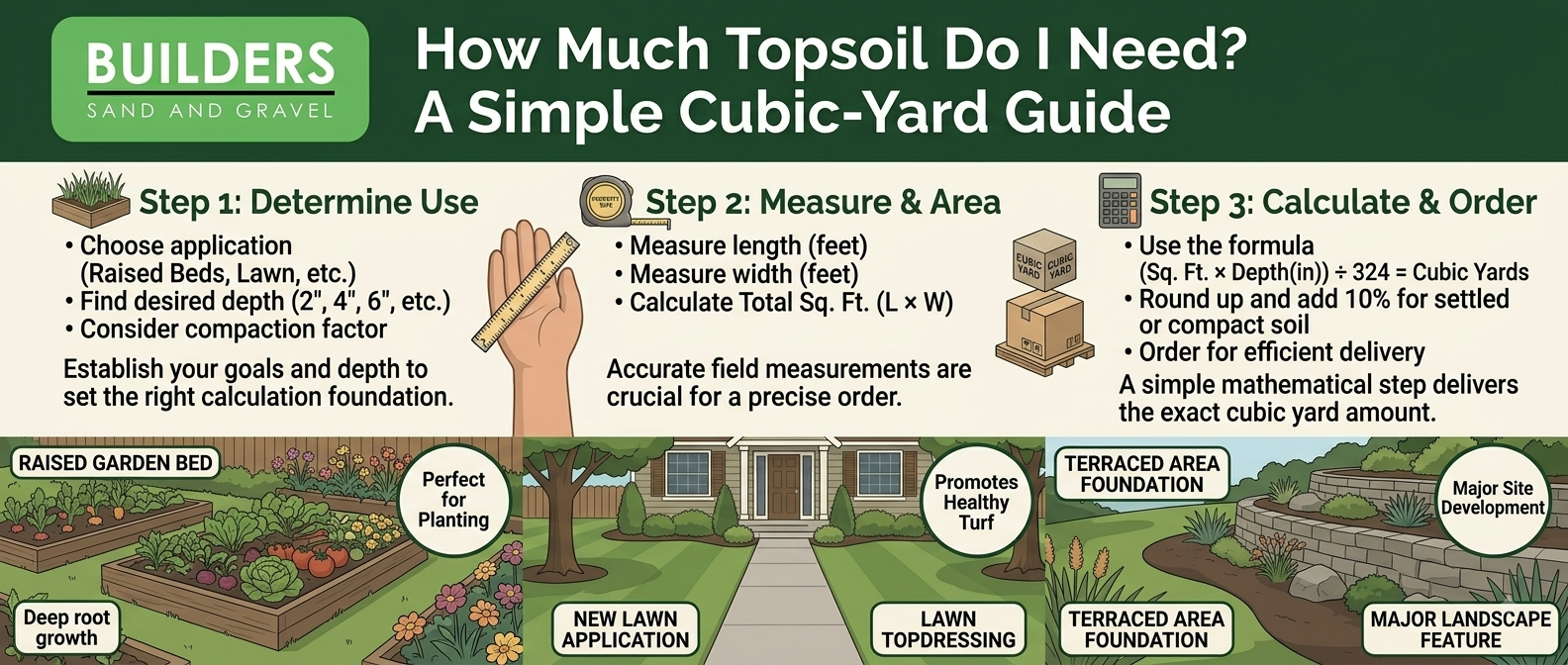
Bulk topsoil is sold by the cubic yard, and one cubic yard is 27 cubic feet. To figure out what you need, measure your area in square feet, choose your depth in inches, and run this calculation:
That’s it. A 10-by-20-foot bed (200 square feet) at 3 inches deep works out to 200 × 3 ÷ 324 ≈ 1.9 – call it 2 cubic yards. Prefer to skip the arithmetic? Our material yardage calculator does it instantly.
Skip the math
Get your cubic-yard total in seconds
Enter your length, width, and depth – the calculator does the rest. Works for topsoil, bark, gravel, and sand.
Depth depends on the job. For top-dressing a thin lawn, an inch is plenty – you want existing grass to grow through it. For amending tired garden soil, spread two to three inches and mix it into the native soil below so roots get a transition zone instead of a hard line. For a brand-new lawn from seed or sod, aim for at least four to six inches of quality soil. Raised vegetable beds are usually filled six to twelve inches deep, often blending topsoil with compost for drainage and nutrients.
A worked example
Say you’re building two raised beds, each 4 by 8 feet, filled 10 inches deep. That’s 64 square feet total. Using the formula: 64 × 10 ÷ 324 ≈ 2 cubic yards. If you plan to mix in compost at roughly one part in three, you’d order about 1.5 yards of topsoil and half a yard of compost – and you’re done in one delivery.
Pro tip
Round up, not down. Soil settles after spreading and watering, so a little extra is rarely wasted – leftover topsoil is easy to use for filling low spots or topping planters. Running short mid-project means waiting on a second delivery.
Common questions
How many bags equal one cubic yard?
A typical bagged soil is 1 to 1.5 cubic feet, so one cubic yard equals roughly 18 to 27 bags. For anything bigger than a couple of planters, bulk delivery is dramatically cheaper and saves the trips.
Can I pick up topsoil at your yard?
Our topsoil is delivery only – no pickup. We deliver across Seattle, Bellevue & Snohomish County, which spares you the truck rental and the shoveling at both ends.
Which blend should I order?
Our standard 3-way topsoil suits most beds and lawns. Winter Mix is sandier, so it drains better in wet seasons and shady, damp areas. Vegetable Garden Mix maximizes nutrients for edible beds, and Organic Compost is the amendment to blend into any of them.
Does the measurement change for odd-shaped areas?
Break the space into rectangles, estimate each one, and add them up. For circles, multiply the radius (in feet) by itself, then by 3.14, to get square feet. Close is good enough – then round up.
Know your number? Let’s get it delivered.
Premium 3-way topsoil, Winter Mix, Vegetable Garden Mix, and Organic Compost, delivered across Seattle, Bellevue & Snohomish County. We also deliver bark & mulch to finish the surface.
Pea gravel is the material most people reach for when they want a patio, fire pit area, or garden path done over a weekend without pouring concrete. It packs into a firm, walkable surface, drains fast in our wet Pacific Northwest winters, and looks finished on its own. Below is the practical information we get asked about most often when people call to order it – how much to buy, what it costs, and how to put it down so it stays put.
What pea gravel actually is
Pea gravel is small, water-rounded stone screened to about 3/8 inch. The rounded edges are what make it comfortable to walk on barefoot and easy to rake level. It arrives in mixed natural tones of tan, brown, gray, and off-white, so it sits well against most homes and planting beds. Because it is washed before delivery, you are not dealing with the dust and clay film you get from crushed product.
One thing worth knowing up front: pea gravel does not lock together the way angular crushed rock does. That is why it feels loose underfoot and why edging matters so much, which we cover further down.
How much pea gravel you need
This is the question we field most. Work out your square footage first (length times width), then decide on depth. Two inches is plenty for a path or a decorative bed. Go to three inches for a patio or fire pit seating area that will get chairs and regular foot traffic, since a thin layer shifts and shows the fabric underneath.
A cubic yard of pea gravel covers roughly 160 square feet at 2 inches deep, or about 108 square feet at 3 inches. So a 10-by-12 patio (120 square feet) at 3 inches needs a little over one yard – round up to a yard and a half to allow for settling and the low spots you will not notice until the gravel is down.
Project
Depth
Coverage per cubic yard
Garden path or border
2 inches
about 160 sq ft
Patio or seating area
3 inches
about 108 sq ft
Fire pit surround
3 inches
about 108 sq ft
Dry creek bed
2 to 3 inches
about 110 to 160 sq ft
What pea gravel costs
Once a project is bigger than a few square feet, buying by the cubic yard is far cheaper than bagged gravel. A bag from the hardware store covers a tiny area and a patio can swallow forty or fifty bags, so you pay a premium and spend your Saturday hauling them. Bulk delivery skips both problems. The actual price depends on how many yards you order and how far the truck travels, so the honest answer is to get a quote with your address and quantity rather than trusting a per-bag figure.
Project ideas
Patio. A pea gravel patio is the most popular weekend build. Excavate a few inches, set a firm edge, lay landscape fabric, add a compacted crushed-rock base, and top with pea gravel at about 3 inches. You get a soft, fast-draining surface you can use the same day, at a fraction of the cost of pavers or poured concrete.
Fire pit area. Pea gravel makes a clean, low-maintenance surround for a fire pit. It stays cooler than stone in the sun and gives you a level spot for chairs. Keep the seating zone clear of the flame, and use a metal ring or pavers for the pit itself.
Garden paths. A 2-inch layer over fabric, held in with edging, makes a tidy path between beds. It drains well and is forgiving on uneven ground, so you do not need a perfectly flat run to make it look right.
Dry creek bed. Combine pea gravel with a few larger river rocks to mimic a natural streambed. It doubles as a drainage channel for runoff, which is useful on the wetter properties around here.
Putting it down so it stays put
Most pea gravel problems trace back to two skipped steps: no edging and no base. Loose stone wants to spread, so it will creep into your lawn or beds without a hard border of steel, stone, or pressure-treated lumber to contain it. And on bare soil it sinks and turns muddy, so lay landscape fabric first, then a compacted layer of crushed rock under any patio or fire pit before the pea gravel goes on top. That base is what keeps the surface from rutting when you set a chair on it.
For a fire pit, set the ring itself on the crushed-rock base for stability and reserve the pea gravel for the seating zone around it. It stays cooler than pavers in direct sun and gives you a clean, level spot for chairs.
Common questions
Can you walk on it barefoot? Yes – the rounded edges are why pea gravel is the usual pick for patios and pool surrounds rather than sharp crushed rock.
Will weeds grow through it? Far fewer if you put landscape fabric underneath. A 2 to 3 inch layer over fabric blocks most of them; the occasional seedling pulls out easily.
Is it good for drainage? It drains well, which is why it works for dry creek beds and around downspouts. For a French drain or footing drainage you usually want a larger washed drain rock instead.
Tell us your square footage and we will help you figure the yardage. We deliver pea gravel and washed gravel across Seattle, Bellevue, Everett, and the Eastside, plus crushed rock for your base layer. Contact Builders Sand & Gravel for a delivery quote.
Gravel is one of the most useful materials you can put down around a property. It builds driveways, lines pathways, improves drainage, and finishes a planting bed, all without pouring concrete or waiting on a crew. The one catch is weight: a single cubic yard runs about 2,700 pounds, so a smooth delivery comes down to knowing what to order and having the area ready before the truck pulls up. Below is the practical rundown we walk customers through most often when they call to order.
The 10 steps to prepare for your gravel delivery
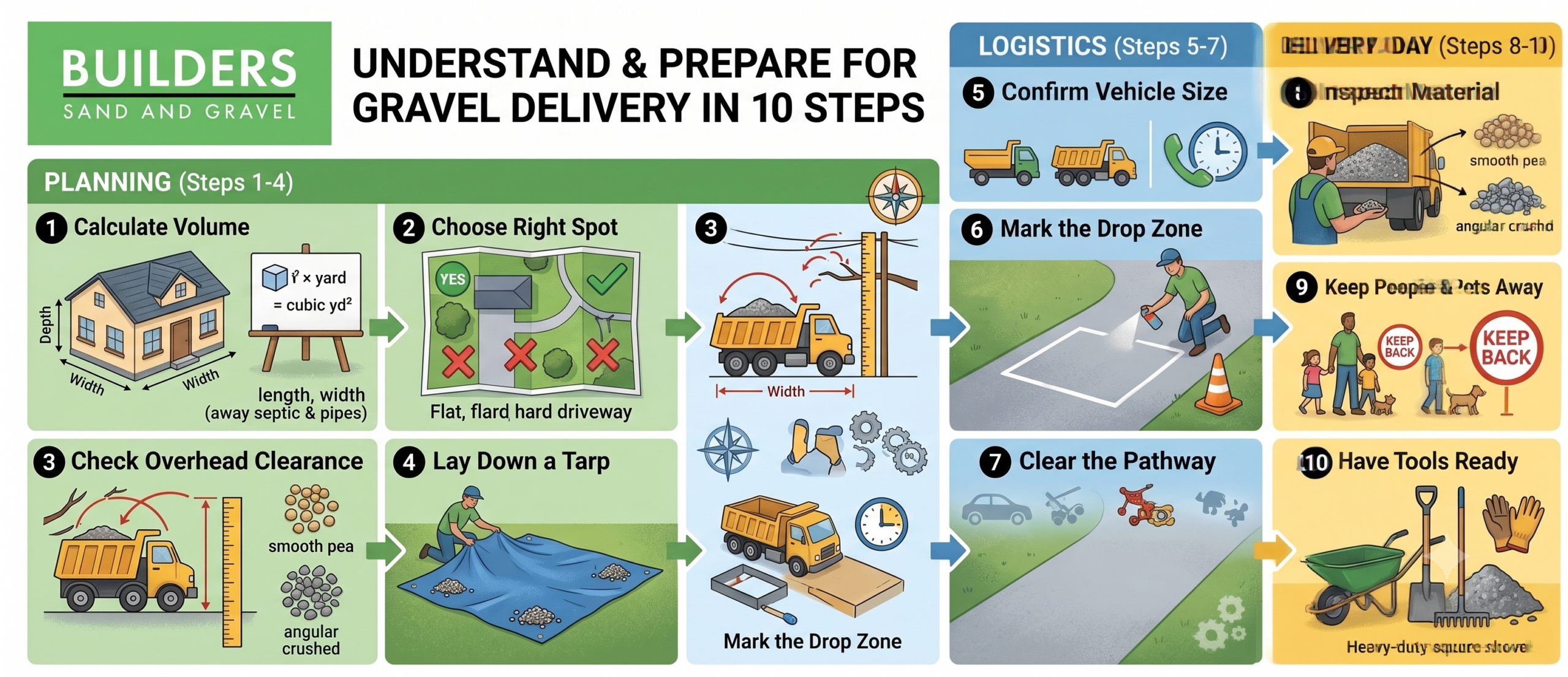
Here is the short version of getting ready for the truck. The sections below go deeper on the material itself, but these are the steps that make delivery day go smoothly.
Calculate volume. Measure length, width, and depth to work out how many cubic yards you need.
Choose the right spot. Pick a flat, firm drop area, clear of the septic system and underground lines.
Check overhead clearance. Make sure there is room for a raised dump bed, away from wires and branches.
Lay down a tarp. Putting a tarp under the drop zone keeps the gravel clean and makes cleanup easy.
Confirm vehicle size. Check that the delivery truck can reach the spot and turn around.
Mark the drop zone. Flag exactly where you want the pile so the driver places it right the first time.
Clear the pathway. Move cars, toys, and obstacles so the truck and your wheelbarrow have a clear route.
Inspect the material. Confirm you are getting the right product, whether that is smooth pea gravel or angular crushed rock.
Keep people and pets away. Keep kids and animals back from the truck and the drop zone during delivery.
Have your tools ready. A wheelbarrow, a heavy-duty square shovel, and a rake make spreading the gravel far easier.
What gravel actually is
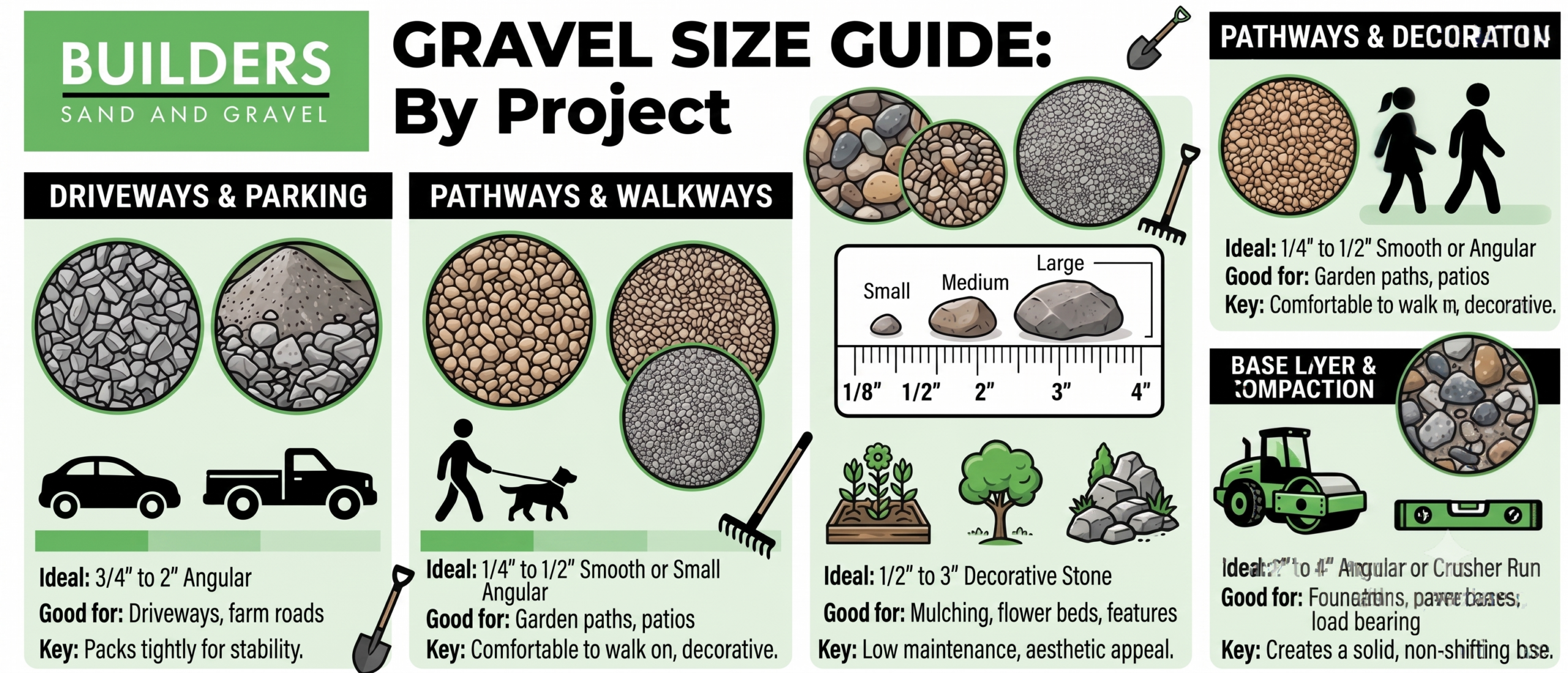
Gravel is small stone, roughly 1/8 inch to 3 inches across, used for pathways, driveways, and around plants to help water drain. Some of it is smooth and water-rounded, some is crushed so the edges are sharp and angular, and that difference is what makes one type right for a garden path and another right for a driveway. As a rough guide, a single cubic yard covers about 100 square feet at a depth of 3 inches.
The main types of gravel
Crushed gravel. This is the workhorse. It is made from crushed rock, comes in a range of sizes, and the angular edges lock together, which is why it is the usual pick for driveways and as a base under pavers.
Pea gravel. Small, round stone about the size of a pea. The smooth surface is comfortable underfoot, so it tends to go down on pathways, play areas, and around plantings rather than under traffic.
What size you should use
The right size comes down to the job. For a pathway you want smaller stone that is easy and comfortable to walk on. For a driveway you want something larger and more durable that holds up under the weight of vehicles. Think about the purpose first and the load it has to carry, and the size mostly sorts itself out.
How much you need
This is the question we field most. It depends on the area you are covering and how deep you want the gravel to sit. Work out your square footage, decide on a depth, and then order a little more than the math says to allow for calculation errors and the obstacles you will not notice until you start. The table below gives a quick reference for common materials and where they fit.
Type
Typical size
Common use
Pea gravel
about 3/8 inch
Paths, play areas, plantings
5/8 inch minus
5/8 inch and down
Driveways and paver base
Crushed drain rock
about 1 1/2 inch
Drainage and dry wells
2 inch minus
2 inch and down
Heavy-use base layer
Keep the weight in mind too. At roughly 2,700 pounds per cubic yard, you need a plan for moving and spreading the gravel once it is delivered. If you tell us your square footage, we are happy to help you figure the yardage.
A quick example: a 200-square-foot driveway at 3 inches deep needs about 2 cubic yards of gravel, and a 100-square-foot garden path at 2 inches deep needs roughly 1 cubic yard. Order a little extra to cover settling and low spots.
Preparing the area
Good prep is what makes gravel last. Start by clearing any grass, weeds, or other vegetation and leveling the ground with a rake or shovel. For a driveway or another heavy-use area, dig down and lay a compacted base of crushed stone first so the surface has something solid to sit on. Drainage matters as much as the base, so build in a slope or a simple drainage system (a coarse drain rock works well here) to keep water moving away rather than pooling under the gravel.
Installing it
Once the area is ready, move the gravel from the truck with a wheelbarrow or a heavy-duty cart, then spread it evenly with a rake, working out any piles or low spots as you go. Uneven gravel is both a tripping hazard and a drainage problem, so take the time to level it. When it is spread, compact it with a hand tamper or a rented plate compactor so it stays put.
Maintaining it
Gravel is low maintenance, not no maintenance. Rake it now and then to keep it level, clear off debris as it collects, and top up any spots where the stone has thinned, sunk, or shifted over time. If a whole area starts sinking or going uneven, add fresh gravel and compact it more thoroughly.
Gravel or mulch?
Gravel around plants does help with drainage, but it is not a straight swap for mulch. Mulch retains moisture, suppresses weeds, and feeds the soil as it breaks down, none of which gravel does. Gravel also reflects heat, which can make a hot, sunny bed even hotter on the plants, so reach for it where drainage is the goal rather than as a blanket replacement.
Common questions
How do I choose a delivery dealer? Look for a supplier with a solid reputation and real customer reviews and testimonials. A dependable dealer makes the whole project easier from the first phone call.
How do I get started? Contact us about pricing and delivery options. Builders Sand & Gravel, Inc. is the premier crushed rock and driveway gravel supplier to Seattle, Bellevue, and Snohomish County. Our crushed rock is a blue-gray basalt, and we also carry crushed ledge rock, 5/8 inch clean, 5/8 inch chips, type 22, 3/4 inch chip, 1 inch clean, 1 1/2 inch crushed drain rock, crusher run, 2 inch minus, 4 to 8 inch, permeable base rock, and permeable top course. We deliver other colors as well, so call for details.
Gravel is not one-size-fits-all, and picking the right size is the difference between a project that lasts and one you patch every spring. The size you need depends entirely on the job: a driveway, a drainage trench, and a garden path each call for something different. Here is a straightforward guide to choosing the right gravel size, based on the questions we answer most often when people call to order.
Why gravel size matters
Stone size affects how a surface drains, how well it compacts, how it feels underfoot, and how long it lasts. Using the wrong size is the most common reason a gravel project disappoints, so it is worth a moment to get right before you order. The good news is that matching size to project is simple once you know what each job needs.
What size gravel for a driveway
A solid driveway is built in layers with different sizes of stone rather than a single dumped load. A larger, angular base rock such as 2 inch minus goes down first for strength, followed by a mid-size layer, then a finer top course that locks together into a smooth, drivable surface. Building it up this way is what keeps you from replenishing the gravel every spring. If you want it done right, plan on more than one size. You can read more about our crushed rock and driveway gravel options.
What size gravel for drainage
For drainage, you want a washed, rounded stone roughly 1/2 inch to 1 inch across. That size leaves plenty of gaps for water to move through freely, which is exactly what a French drain, a dry well, or downspout runoff needs. A finer stone would pack too tightly and slow the water down. A coarse drain rock is the right call here.
What size gravel for paths and weed control
For walkable paths, smaller and smoother stone is the most comfortable underfoot, which is why pea gravel is the usual pick. For holding back weeds, a fine gravel laid about an inch deep over landscape fabric does the job, blocking light while still letting water through.
A quick size guide by project
Project
Suggested size
Why
Driveway base
2 inch minus
Strength and a solid foundation
Driveway top
5/8 inch minus
Locks together into a smooth surface
Drainage
1/2 to 1 inch washed
Lets water move freely
Paths and play areas
pea gravel, about 3/8 inch
Comfortable and easy to walk on
Weed control
fine gravel, ~1 inch layer
Covers soil and blocks light
Common questions
How small is driveway gravel? The top course is usually a fine crushed product like 5/8 inch minus, which packs down into a smooth surface, while the base layer underneath is larger for strength.
Can I use one size for the whole driveway? You can, but it will not hold up as well. A layered build with a coarse base and a finer top lasts far longer and needs less replenishing.
What size is best for drainage? A washed stone in the 1/2 inch to 1 inch range gives the open gaps that let water move through quickly.
Still not sure what size to order? Tell us about your project and we will point you to the right material. A quick conversation up front saves time and money later.
Not sure which size fits your project? Tell us what you are building and we will recommend the right material. Builders Sand & Gravel delivers crushed rock, drain rock, and gravel across Seattle, Bellevue, and Snohomish County. Contact us for a delivery quote.
Spring is just around the corner. If you want an outdoor space that you can enjoy as soon as the flowers bloom, now’s the time to start sprucing up your yard. One of the best ways to do that without breaking the bank is to install a new gravel or crushed rock patio. In 2017, a Houzz Landscape Trends study found that 38% of homeowners that upgraded their patios, terraces, pathways, or driveways used gravel or crushed rock. Here’s why these materials are so popular and how you can use it in your next DIY project.
Less Expensive
Many homeowners are choosing to go to their local gravel dealer when they build a new patio because gravel and crushed rock can be much less expensive than pavers. A 100 square foot patio could cost you $500 or more if you use pavers. A gravel dealer, on the other hand, will charge you closer to $100 for the gravel or crushed rock to build a patio that’s the same size.
Quicker and Easier
If you’re looking for a quick and easy DIY patio, using gravel as opposed to pavers or other materials might be your best bet. With pavers, you need to dig and level the ground. Then, you need to painstakingly lay each paver so that it’s spaced correctly, which can take a long time. Crushed gravel or rock doesn’t require as much precision because it conforms to the base it’s poured on. For someone without much experience, a gravel patio can be much easier to get right.
Looks Good
One of the best things about using gravel or rock for your patio is that it looks good even if a first-time DIY-er is doing the work. Gravel and rock can hide mistakes much better than a misplaced paver can. Gravel and rock can also look more natural in an outdoor setting than many other materials.
Lots of Options
If you install gravel or crushed rock patio, you might be surprised at the number of different options you have when it comes to size, color, and type of rock your gravel dealer offers. You can choose from pea gravel, washed gravel, or crushed rock — each with a different look and feel underfoot.
No Maintenance
Patios built from wood planks or stone pavers usually have to be power washed, stained, or painted frequently. Gravel patios, on the other hand, are virtually maintenance-free. You don’t have to worry about moss or mildew growing on it, and a leaf blower will get rid of any debris that catches. You may need to add more gravel over the years if yours gets kicked about too much, but adding a border can keep it in place longer.
Now that spring is near, you should consider what DIY outdoor projects you’d like to tackle. Installing a gravel or crushed rock patio can be inexpensive, quick and easy, attractive, and maintenance-free. It’s a project you can do yourself and one that will give you an outdoor space to enjoy for years to come.
Drain rock is uniform gravel that is used to help with drainage. Drainage gravel helps to ensure that water does not pool. It is often used as the first layer in a drainage system.
A trusted gravel dealer will have the drain rock that you need to ensure your project comes together perfectly. This is multi-purpose gravel that can be used for many different applications in your landscaping.
What You Need to Know About Gravel
Gravel is rocks that have been broken into pieces. It comes in different sizes that can be used for different applications. The smallest of the sizes are sometimes referred to as pea gravel. Gravel comes in a wide range of colors (dependent on the quarry of origination). It can be gray, blueish, black or white.
Gravel typically is offered in sizes that range from 3/8ths of an inch, 7/8ths of an inch, 3/4ths of an inch, and 1/2 inch. The edges can be smooth or jagged on the gravel. Drain rock is so named not because of the specific size, color or shape, but because of the application that it will be used for.
This multi-purpose gravel can be used in:
French drains
Trenches
Garden areas, landscaping, and driveways
Gravel can be used anywhere in landscaping. Drain rock (gravel) helps water to drain and can also help to control weeds in the garden. A one-inch layer of gravel in the garden can inhibit weed growth. A simple three-inch trench filled with gravel in areas where there is a drainage problem will in most cases solve the problem.
Driveways, walkways, and garden paths that are constructed with a layer of drain rock and topped off with some decorative river rock Seattle homeowners have found, create a sturdy path that holds up to the largest amounts of rain.
It’s a Natural Solution
Struggling with drainage problems? Drain rock is an easy solution that is natural. You never have to worry about replacing parts, or materials leeching into the ground with drain rock. Get gravel delivery right to your home and cure your drainage problems the natural way.
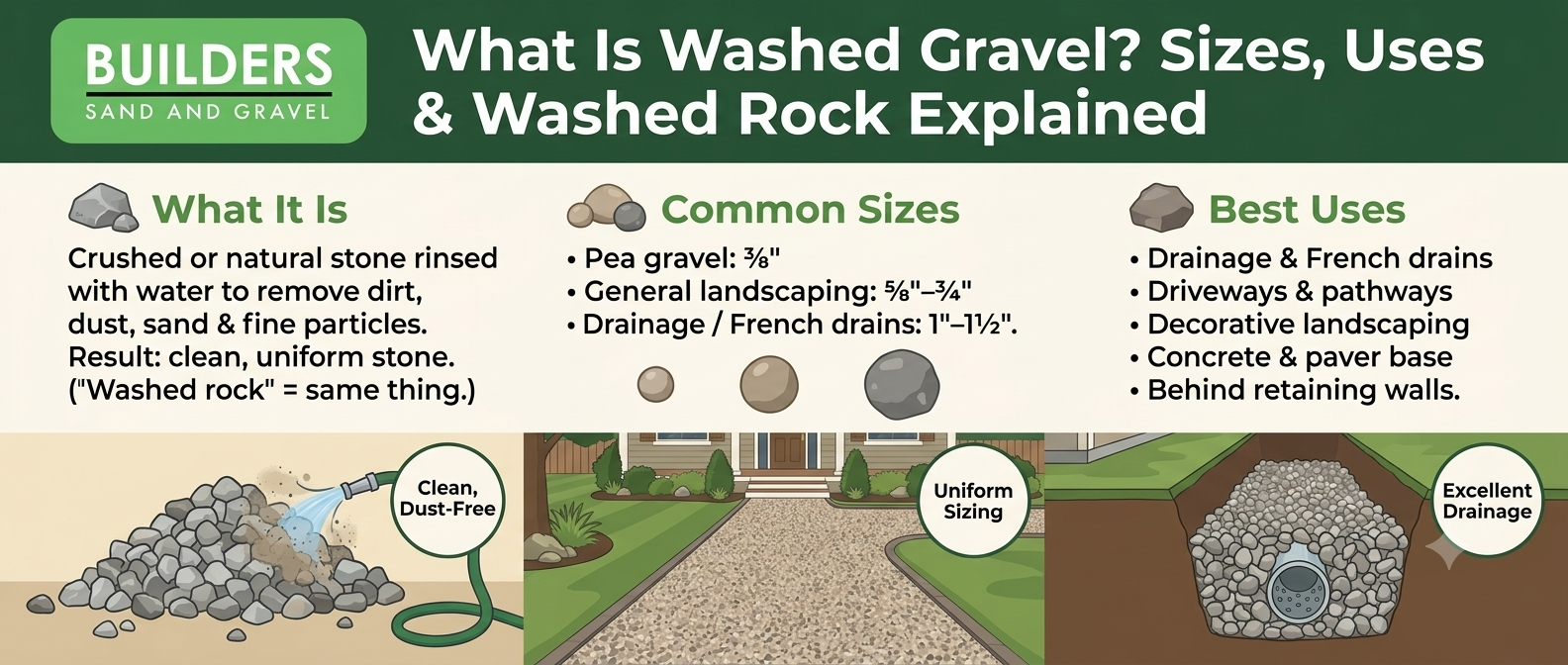
Washed gravel is rock that’s been rinsed with water and screened to remove the dirt, dust, and fine debris that come with raw gravel. The result is clean, smooth-looking stone with no muddy residue, which is why it drains so well and looks far more finished than unwashed material. You’ll also see it sold as washed rock or washed stone; these are the same product, just different names.
The difference matters most in two situations: drainage, where leftover dust would otherwise clog the gaps between stones, and appearance, where a clean, gleaming surface makes a visible difference in a garden bed or pathway.
Washed Gravel vs. Crushed Gravel
The simplest way to understand washed gravel is to compare it to crushed gravel. Crushed gravel is angular and still contains fines (dust and small chips), which helps it compact into a hard, stable base, so it’s good under pavers or driveways. Washed gravel has those fines removed, so it stays loose and drains freely, which makes it better for drainage and decorative use. Neither is better than the other; they’re built for different jobs.
Common Washed Gravel Sizes
Washed gravel comes in a few standard sizes, and the right one depends on the job:
Size
Best For
3/8″ (Pea Gravel)
Pathways, play areas, poolside, and fine decorative work.
5/8″ – 3/4″
General landscaping, drainage beds, and garden borders.
1″ – 1½”
Drainage applications, French drains, and larger decorative areas.
What Washed Gravel Is Used For
Because it drains well and looks clean, washed gravel works almost anywhere outdoors:
Garden beds and borders, for weed control and a finished look
Pathways and walkways
Drainage beds and around downspouts
Play and grilling areas
Poolside surrounds, where a clean surface matters
It’s a low-maintenance way to cover ground that would otherwise need mulch or grass, and it holds up year after year without breaking down.
Ordering Washed Gravel in the Seattle Area
Common questions about washed gravel
What is washed gravel? Washed gravel is gravel that has been rinsed and screened to remove dirt, dust, and fine particles, leaving clean, uniform stone that drains well and looks finished.
Is washed gravel the same as washed rock? Yes. “Washed gravel” and “washed rock” refer to the same thing — clean, rinsed stone. The terms are used interchangeably here in the Seattle area.
What is the best size of washed gravel? It depends on the job. Smaller sizes (⅜″–¾″) work well for pathways and pipe bedding, while 1½″ is the most common choice for drainage and base applications.
What is washed gravel used for? Common uses include drainage and French drains, pipe bedding, decorative landscaping, and clean base layers where you don’t want dirt mixed in.
Where can I buy washed gravel near me? Builders Sand & Gravel supplies washed gravel throughout the Seattle, Bellevue, and Snohomish County area, with delivery and pickup available.
Not sure which size suits your project, or whether washed gravel or crushed rock is the right call? We can help you sort that out before you order. We deliver washed gravel, drain rock, and river rock throughout Seattle, the Eastside, and Snohomish County. Contact Builders Sand & Gravel to get started.
How can getting a crushed gravel delivery change everything about the way your yard looks? Well, it’s time to find out. Everyone knows that landscaping is a big part of any home. A house that doesn’t have good landscaping just doesn’t look nice. On the other hand, a home that’s surrounded by great landscaping is far more noticeable and looks far nicer. Good landscaping increases the value of your home. And getting a crushed gravel delivery can help you get amazing-looking landscaping.
What Happens with Crushed Gravel Delivery?
Crushed gravel actually has a ton of uses. Not only can this be used in landscaping areas, but it can also be used for driveways and walkways. There are many types of gravel, from pea gravel to river rock, and you can get crushed gravel delivery with all sorts of specific types of rock to create the exact look for your property that you want.
When you order crushed gravel delivery, usually from a quarry or a landscaping company, you will schedule a specific day to receive the delivery. A large truck containing the gravel will arrive at your property and dump the gravel as specified. You may have the gravel dumped in multiple places. Usually, the delivery person or people driving the truck and dumping the gravel will also spread out the rock somewhat.
There are many reasons why you should use crushed rock in your landscape, and not just because it looks very nice. There are actually many practical reasons why this is such a great addition to your overall outdoor design.
What Can Crushed Rock Do?
A mere one-inch layer of crushed rocks, gravel, or small rocks provides weed control. The weeds have trouble growing between the rocks. The soil does not receive direct sunlight that would otherwise facilitate the growth of weeds, and the weeds have no place to go because they push up through the soil and encounter rocks instead of air. Crushed gravel also helps to keep soil in landscaping areas moist. Any kind of covering on all types of topsoil can help the soil stay moist by allowing it to retain more water. This is why mulch is used; it helps the soil retain water after rainfall by preventing evaporation. Crushed rock does the same thing, and many people find it much more attractive then mulch.
Gravel is a long-lasting material. Where mulch has to be replaced every year and frankly begins losing its looks well before the summer season is over, crushed rock is highly durable. It takes a long time for crushed gravel to lose its color, and it can be washed off if it begins to look dirty or mossy. When it’s time to replace the look of your landscaping again, you can always order another crushed gravel delivery.
Landscaping greatly increases your home’s value and your home’s curb appeal. If you make a landscaping investment before you sell your home, that money will come back to you probably tenfold in resale value. It’s worth it to take the time and spend a little extra money on beautifying the outside of your home because this is what people will see.
Driveway gravel is simply crushed rock pieces. A lot of people make the mistake of installing driveway gravel by having a gravel delivery, then just spreading the gravel out and calling it a day. The fact is if you want your driveway to keep its shape there is a process you need to follow.
Your first step, of course, is to connect with a gravel dealer that offers gravel delivery. Then, you will want to learn the proper way to install a gravel driveway to get the best results.
How Small Is Driveway Gravel?
Here is a little fact that most people do not know. Driveway gravel comes in different sizes, which is an important attribute. Experts recommend that you use 3 different layers of 3 different sized gravel. The first layer should be about baseball-sized rocks, the second layer should be about 3 inches of golf-ball-sized rocks, and finally, the third layer should be about 3 inches of marble-sized rocks.
Gravel is graded by size. For example, large baseball size gravel is usually a #3 gravel. When you speak with the supplier just let them know what you are using the gravel for and they will be able to tell you what sizes you need to get the job done.
Preparation is Key
If you want a highly functional gravel driveway that gives you years of coverage, and holds it shape, it is important to prep the driveway. The driveway will turn out better if you prep the area first by smoothing out the surface, remove any debris, vegetation, and filling in any holes.
Compact Your Driveway Between Layers
You will want to be sure that you compact each layer of stone. You can do this with a roller or by driving a vehicle up and down the driveway. You can also use stone fine or dust to help the process. Compaction is an important step.
If you plan on eventually paving your driveway keep in mind that the professionals recommend that you wait two full years after your gravel installation to pave. The type of soil you have in your driveway will play a vital role in how the gravel settles.
Avoid This, the Biggest Mistake
Do not take short cuts when it comes to drainage. Be sure that you incorporate drainage into your driveway design. If you do not take the steps to plan for drainage in your driveway, heavy rain can cause your gravel (and hard work) to wash away.
Many homeowners choose to call in a contractor to install drainage. It is a worthy investment that will help to protect your driveway.
Another big mistake would be to skip layers. Do not skip layers of gravel. It is very important that you use a sufficient amount of gravel, and that you follow the layering suggestions. Connect with a trusted source for all your gravel needs today it will help the project to come together perfectly.
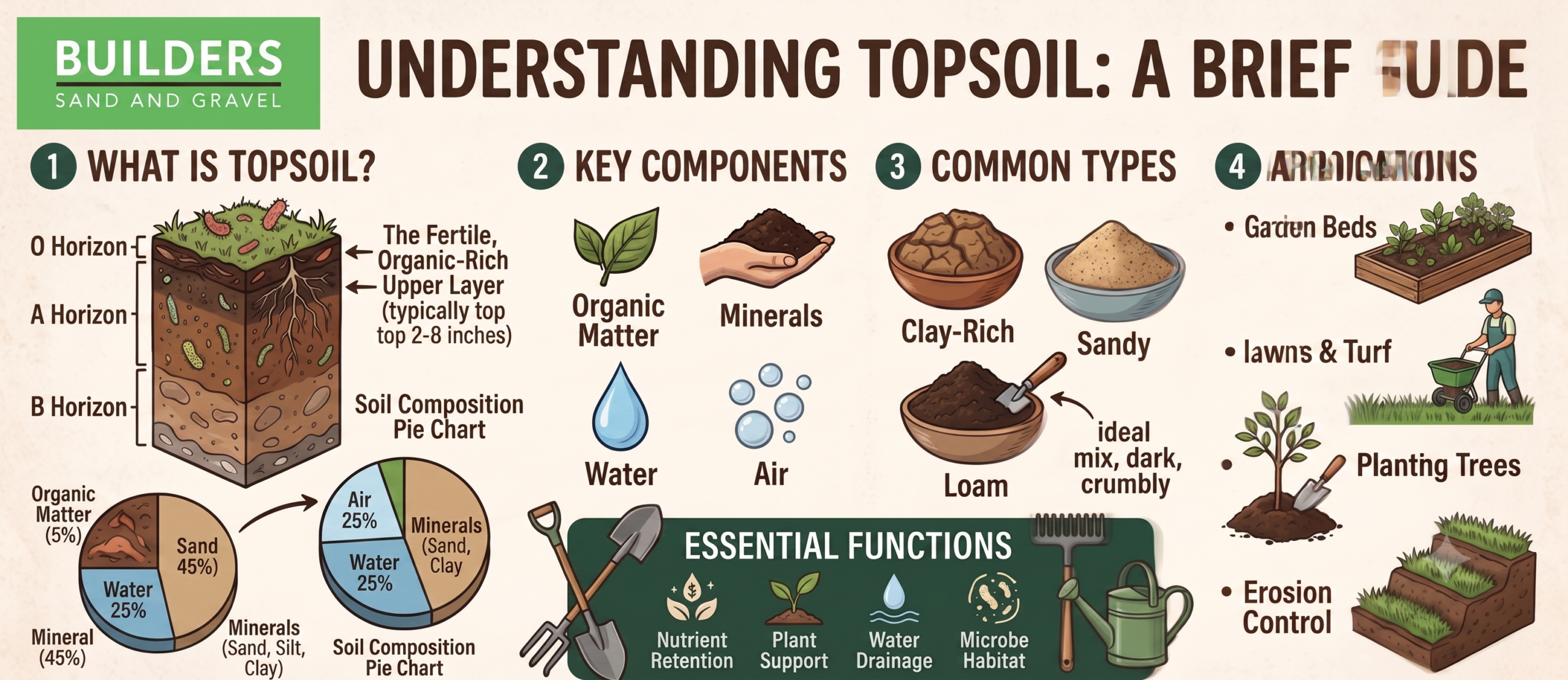
Topsoil is the dark, nutrient-rich top layer of soil where most plants do their growing — and choosing the right kind makes the difference between a garden that thrives and one that struggles. Most people know they need topsoil, but fewer know there are different types or what each is best for. Here is a straightforward guide to what topsoil is, the types available, and how to pick the right one before you order a delivery.
What topsoil is made of
Topsoil is a blend of three mineral particles — sand, silt, and clay — in varying proportions, along with organic matter. A well-balanced, all-purpose topsoil is roughly 60% sand, 25% silt/loam, and 15% clay. Those proportions hold moisture and nutrients while still draining well, which makes it a good growing medium for most plants and shrubs.
The main types of topsoil
Sandy topsoil drains quickly and works well for succulents and drought-tolerant beds. Clay-heavy topsoil holds moisture and nutrients but drains slowly. Loam is the balanced, sought-after mix that suits most gardens. Because proportions vary from supplier to supplier, it is worth ordering from a trusted source so you know what you are getting.
A quick look at topsoil composition
Component
Typical share
What it does
Sand
~60%
Drainage and structure
Silt / loam
~25%
Holds moisture and nutrients
Clay
~15%
Nutrient retention
How to choose the right topsoil
Match the soil to the garden. Sandier mixes suit succulents and Mediterranean plantings, while balanced loam is ideal for lawns, vegetable beds, and most flower beds. If you are unsure, describe your project to your supplier and they can point you to the right blend.
Topsoil vs. potting soil
A common mistake is using topsoil in containers. Topsoil is meant for in-ground beds, while potting soil is specially formulated and enriched for pots and planters. For anything in a container, reach for potting soil instead.
Starting and finishing your garden
The easiest approach is to source your topsoil and bark mulch from one supplier so everything arrives together. Spread the topsoil, mix it into the existing soil for even distribution, plant your plants, then finish the bed with a layer of bark mulch — often achievable in a single day.
Common questions
What is topsoil made of? A mix of sand, silt, and clay plus organic matter, ideally around 60% sand, 25% silt/loam, and 15% clay.
What are the types of topsoil? Sandy, clay-heavy, and loam — with loam being the balanced all-purpose choice.
Can I use topsoil in pots? It is best not to. Use potting soil for containers, since it is enriched for that purpose.
How much topsoil do I need? It depends on the area and depth of your bed. Tell us your project and we can help you estimate.
Planning a garden? Tell us about your project and we will recommend the right topsoil and bark. Contact Builders Sand & Gravel for topsoil delivery across Seattle, Bellevue, and Snohomish County.

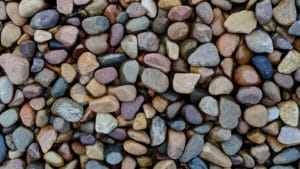
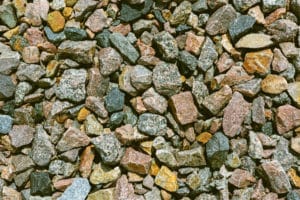
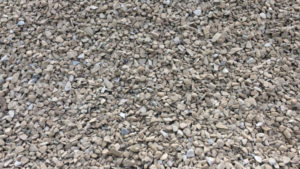 How can getting a crushed gravel delivery change everything about the way your yard looks? Well, it’s time to find out. Everyone knows that landscaping is a big part of any home. A house that doesn’t have good landscaping just doesn’t look nice. On the other hand, a home that’s surrounded by great landscaping is far more noticeable and looks far nicer. Good landscaping increases the value of your home. And getting a crushed gravel delivery can help you get amazing-looking landscaping.
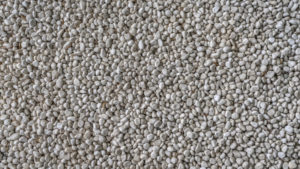 Driveway gravel is simply crushed rock pieces. A lot of people make the mistake of installing driveway gravel by having a gravel delivery, then just spreading the gravel out and calling it a day. The fact is if you want your driveway to keep its shape there is a process you need to follow.