
How Much Topsoil Do I Need? A Simple Cubic-Yard Guide
Every soil project starts with the same question: how much do I actually need? Order too little and the job stalls mid-weekend; order too much and you’re staring at a mound of dirt with nowhere to put it. The good news: estimating topsoil is simple math, and this guide walks you through it step by step.
The formula: from square feet to cubic yards
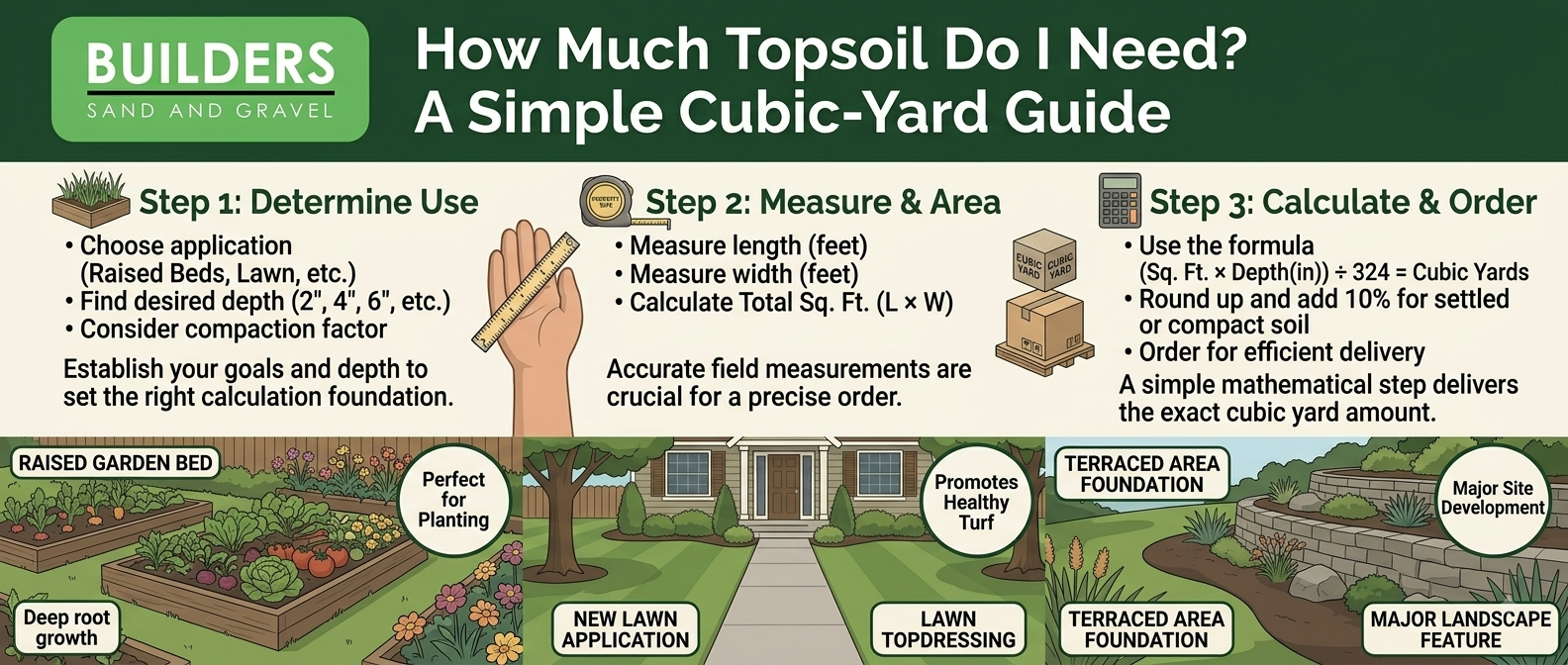
Bulk topsoil is sold by the cubic yard, and one cubic yard is 27 cubic feet. To figure out what you need, measure your area in square feet, choose your depth in inches, and run this calculation:
(Square feet × depth in inches) ÷ 324 = cubic yards
That’s it. A 10-by-20-foot bed (200 square feet) at 3 inches deep works out to 200 × 3 ÷ 324 ≈ 1.9 – call it 2 cubic yards. Prefer to skip the arithmetic? Our material yardage calculator does it instantly.
Skip the math
Get your cubic-yard total in seconds
Enter your length, width, and depth – the calculator does the rest. Works for topsoil, bark, gravel, and sand.
Try the Material Yardage Calculator →
Free · No signup · Instant results
Quick reference: what one cubic yard covers
| Depth | One cubic yard covers | Typical use |
|---|---|---|
| 1 inch | About 324 sq ft | Top-dressing an existing lawn |
| 2 inches | About 162 sq ft | Amending garden beds |
| 3 inches | About 108 sq ft | New planting beds, leveling low spots |
| 6 inches | About 54 sq ft | New lawns, raised beds, deeper fills |
How deep should the topsoil be?
Depth depends on the job. For top-dressing a thin lawn, an inch is plenty – you want existing grass to grow through it. For amending tired garden soil, spread two to three inches and mix it into the native soil below so roots get a transition zone instead of a hard line. For a brand-new lawn from seed or sod, aim for at least four to six inches of quality soil. Raised vegetable beds are usually filled six to twelve inches deep, often blending topsoil with compost for drainage and nutrients.
A worked example
Say you’re building two raised beds, each 4 by 8 feet, filled 10 inches deep. That’s 64 square feet total. Using the formula: 64 × 10 ÷ 324 ≈ 2 cubic yards. If you plan to mix in compost at roughly one part in three, you’d order about 1.5 yards of topsoil and half a yard of compost – and you’re done in one delivery.
Pro tip
Round up, not down. Soil settles after spreading and watering, so a little extra is rarely wasted – leftover topsoil is easy to use for filling low spots or topping planters. Running short mid-project means waiting on a second delivery.
Common questions
Know your number? Let’s get it delivered.
Premium 3-way topsoil, Winter Mix, Vegetable Garden Mix, and Organic Compost, delivered across Seattle, Bellevue & Snohomish County. We also deliver bark & mulch to finish the surface.