Types of Sand for Landscaping: Fill, Play & Masonry Sand

Written by Builders Sand & Gravel Inc. on . Posted in Blog

“Sand” covers several different products, and picking the wrong one is a common and avoidable mistake. The sand that works as a base under pavers is not the sand you want in a kid’s sandbox, and neither is the sand a mason mixes into mortar. Here is a plain breakdown of the three types we deliver most, what each is good for, and how to tell them apart.

The main types of landscape sand

Most home and construction projects come down to three products: utility sand, play sand, and masonry sand. They differ in how coarse the grains are, whether they have been washed, and what they are meant to do.

TypeTextureBest for
Utility (fill) sandCoarse, unwashedPaver base, backfill, filling trenches and holes
Play (beach) sandFine, softSandboxes, play areas, volleyball courts
Masonry sandFine, washed, cleanMortar, concrete, laying brick and block, paver joints

Utility sand (fill sand)

Utility sand is coarse and a little gritty, usually a mix of white, gray, beige, tan, and brown grains. It is not washed or processed, which is exactly why it compacts so firmly. That makes it the go-to for the base layer under paving stones and for filling trenches and low spots. It is not the soft sand you picture at the beach, but for anything that needs to pack down and hold, it is the right pick.

Play sand (beach sand)

Play sand is the fine, soft sand people associate with the beach. It shows up in sandboxes, backyard play areas, and beach volleyball courts. When it is sold as “play sand” it has been screened to be free of the silica dust you do not want kids breathing, so it is the safe choice for anywhere children dig and play.

Masonry sand

Masonry sand, sometimes called white sand, is fine-grained and washed clean. It mixes into mortar and concrete for laying brick, block, and stone, and it is a touch easier to work with than utility sand. Its clean, light color also makes it the usual choice for the joints between pavers, where a tidy line between stones matters.

Fill sand vs. play sand: which do you need?

This is the comparison we get asked about most. Use fill (utility) sand when the job is structural – a base that needs to compact and stay put under pavers or in a trench. Use play sand when softness and safety matter, like a sandbox. They are not interchangeable: play sand is too fine to give a stable base, and utility sand is too coarse and dusty for a play area.

Not sure which sand fits your project? We deliver utility, play, and masonry sand across Seattle, Bellevue, Everett, and the Eastside, along with crushed rock for base layers. Contact Builders Sand & Gravel and we will point you to the right product and quantity.

Summer Sandbox Fun: 5 Design Ideas Your Kids Will Dig

Written by Builders Sand & Gravel Inc. on . Posted in Blog

crushed gravelAs summer draws near, your thoughts may be turning to fun afternoons outside enjoying your yard and getting you and yours some fresh air and sunshine. A survey for the National Association of Landscape Professionals found that 75% of Americans value time spent outside in the yard. A new sandbox makes a great addition and extra attraction, and is relatively easy to build. Sand for sandboxes comes in various forms. You can use fine sand or a combination of utility sand, construction sand, and crushed gravel for your fill. Sand and gravel delivery service makes the fill process that much easier. There’s always the classic sandbox, but consider these creative ideas for the coolest sandbox in the neighborhood.
The Pallet Box. Rather than tossing out those used pallets, they can be sanded, painted, assembled into formation and filled with sand for an easy play piece.

The Picnic Table Box. This idea is great for those with smaller yards that may not have sufficient room for a full-size sandbox, and provides both seating and sand play. Simply build a frame around the table top, fill it with sand, and add pals and shovels. Your kids can sit or kneel on the table’s seats while building sand castles on the tabletop.

The Tire Box. If you’ve got an old tractor, or other large tire, you can simply lay down liner under the tire, paint the tire in fun colors if you wish, and fill the center with sand. Adhering pool noodles to metal edges keeps things safe.

The Bed Box. This one requires a flat platform bed frame. Fill with sand or a combination of sand and crushed gravel and you are good to go. Bonus points for bed frames with a headboard. Fasten a chalkboard onto the headboard for extra fun.

The Tent Box. Repurpose that old or unused camping tent that’s just taking up space and turn it into a sandbox complete with shade. Once the tent is set up and filled, kids can play inside. This option is also great for kids especially sensitive to direct sun exposure.

One caution: If you make your sandbox cool enough, your yard may become the go-to fun spot for the neighborhood. You may need to stock up on lemonade and refreshing cocktails for your parent friends.

5 Reasons to Use Washed Gravel in Your Landscaping Plan

Written by Builders Sand & Gravel Inc. on . Posted in Blog

when to use washed gravelThere are a number of reasons to use washed gravel in your landscaping. Some people wonder about when to use washed gravel, what is the answer? Whenever you want! But what are the benefits of using washed gravel when updating your landscaping:
  1. It is very cost effective. This is one of the biggest pluses of using washed gravel. When you are looking to change up the look of your property, this is a great way to go if you are on a tight budget. Washed gravel is less pricey than other kinds of materials for landscaping. If you are wondering when to use washed gravel, it works well for driveways and paths around a property. It has a lot of benefits that concrete and asphalt cannot match. It is also less expensive to have delivered and installed.
  2. It is easy to maintain. Washed gravel is very easy to maintain. In order to get the best results, you should order a little more than is needed when you get your gravel delivery. If you see a patch in the crushed gravel that is uneven, all you need to do is rake it over. This is way easier than fixing cracks in concrete and asphalt. With gravel, there is no need to get coatings that cost a lot or spend a lot of time sealing the area. You will have to schedule a new gravel delivery every two years or so.
  3. It is great for weed control. If you live in an area of the country where weeds are always on the verge of taking over your property, you may want to answer the question of when to use washed gravel, AS SOON AS POSSIBLE! No one likes to deal with weeds and they can wreak havoc on an area covered with concrete or asphalt. The roots from the weeds can do a number on other landscaping materials.
  4. You can get your gravel in a number of styles. It also comes in different textures, sizes, colors, and grades. The two most popular styles are crushed and washed. There are a lot of other gravels you have to choose from. No matter what kind of look you want for your landscaping, you can get it with gravel.
  5. It is great at soaking up rainwater or letting it flow right by. All gravel is drainage gravel. If you have your gravel installation done correctly, you will eliminate any problems with drainage. When you have asphalt or concrete, rainwater can really do a lot of damage. Especially when it teams up with the weeds that have popped through the surface. Gravel is comprised of individual rocks. Water can wash through them and not cause any problems. Because a surface of gravel cannot crack, water cannot get in and make cracks larger. This is another reason this is a good material that needs little in the way of maintenance.

There are a lot of reasons washed gravel makes a great addition to any landscape plan. It is cost-effective, can match and meet any style, is easy to install and maintain, and is versatile.

Ensure Optimal Plant Growth By Picking the Right Topsoil

Written by Builders Sand & Gravel Inc. on . Posted in Blog

gravel deliverySpring is upon us, and many are looking into different types of flowers to add to their garden. Picking out new arrangements and preparing for new things to blossom in your yard space is exciting, but knowing your soil is important for ensuring your plant life thrives.
Good landscaping can bring happiness and contentment to a homeowner’s mindset, and it will increase your home’s curb appeal, too. In fact, some have reported a 14% increase in resale value thanks to improved landscaping. If you are ready to get started, but aren’t sure what steps to take in terms of topsoil, let us help you out.

Read below, then contact Builders Sand and Gravel for all of your landscaping needs. We have the tools and products to set you up right.

Fertility and Texture

There are two main components when it comes to picking the right soil for your needs: fertility and texture. Fertility has a lot to do with the physical features of the topsoil. The texture actually plays a big role in soil fertility, but soil structure, as well as how well it holds water, will make a difference in how successful the plant life is, as well.

Now, when it comes to texture, there are three different thing types of topsoil you can pick from. These are sand, loam, or clay. Clay will retain the most water, which seems beneficial for plant growth, but can wind up drowning them if you are not very cautious. Sand, on the hand, is typically too dry. Plants in sand need a lot of water and can easily dry out on days where the sun is especially hot.

The ideal topsoil comes in the form of loam, which is a mixture of sand and clay. It creates the ideal texture and will be able to hold water well, without leaving your plants in a puddle.

Need Gravel Delivery?

Once you have your flower bed all set up and ready to grow, it may be time to invest in landscaping rocks and gravel. Not only will this help complete the look, but it can help control weed growth, as well. Gravel delivery services are just a phone call away, and it could add the perfect finishing touch to your landscape.

Here at Builders Sand and Gravel, we offer gravel delivery, as well as dirt removal services and topsoil delivery, and we are happy to sell you all kinds of landscaping materials, such as rockery rocks, pea gravel, utility sand, and more. Give us a call today, and we would be happy to work with you.

Peaceful Playground: 3 Ways To Transform Your Backyard With Sand

Written by Builders Sand & Gravel Inc. on . Posted in Blog

utility sandUtility sand is an extremely versatile product. With the right application and creative idea, you can turn an ordinary backyard into a landscaping dream. Unfortunately, it can sometimes be a challenge to come up with clever and inventive ways to use a somewhat generic material. We figured we’d give you a push in the right direction with these three ways to use utility sand in your yard.

  • Sand Bed: If you live in the southern U.S. — or simply prefer its climate and flora — you know that grass is hard to come by. Many homeowners switch to the very low-maintenance utility sand and rock lawns to conserve water without sacrificing appearance. Succulents and cacti thrive in sand, but you must make sure your climate is suited to their health before beginning your own sand and rock garden.
  • Natural Sandbox: Kids love to play in the sand. Encourage imagination by building them a sandbox of their own; they can even help you design and construct the final product as an added bonding experience. Soon enough, your afternoons will be filled with sand castles and grand adventures.
  • Modernize It: You don’t need to love the south to crave the simplicity of a sand or rock garden. In fact, many modern homes (especially those with small yards) are doing away with grass voluntarily because lawn care can be so taxing. With the right design, your sand and rock yard will carry the sophistication of a well-manicured lawn without actually needing any real manicuring. Let the stress of yard work go by transforming your green oasis into a desert oasis and bask in the relaxation.

The creativity doesn’t have to stop at sand. Crushed rocks, washed gravel, and rockery rocks can all contribute to a backyard that is elegantly styled, and uniquely your own. In fact, approximately 38% of homeowners are interested in upgrading their driveways to the more rare gravel and crushed rock look. Landscapes are very flexible when it comes to design; rather than sticking to the classic (and somewhat boring) clean-cut backyard, experiment with landscaping rocks and see where your imagination takes you.

What Is Topsoil and Why Is it Important?

Written by Builders Sand & Gravel Inc. on . Posted in Blog

types of topsoilHealthy and good-quality topsoil can do wonders for your overall landscaping process, and it ensures your plant life stays happier and healthier. Topsoil is the outermost layer of soil in which you plant your flowers and other plants. Most topsoil will be around five inches thick, but it could range anywhere between two and ten inches thick.
It is essential to find the right types of topsoil for your specific needs and preferences, so do not just assume any bag of dirt will do. Learn more below.

What Kind of Topsoil do I Need for my Garden?

There are three different types of topsoil you can invest in for your gardening needs. You can choose between sand, clay, or loam, and each has different benefits. 

Clay will form into a ball when squeezed together, and it is known for having good water retention. While most assume this is perfect for gardening, it could cause you to drown your plants if you are not careful enough.

Sandy topsoil is made up of larger particles that tend to drain quicker than other types of topsoil. You will need to water plants in sandy soil a lot more often, especially in the summer when the heat causes it to dry out quickly.

Loam is a mixture of sand and clay, and most gardeners will deem this as the ideal type to invest in for plant growth. You can think of it as the best of both worlds, in that it holds moisture well, but you face less risks when it comes to over-watering.

Depending on what you are planting, different types of topsoil might work better based on your needs, so do your research, and never hesitate to ask a professional for advice. In no time, your landscaping will be right where it needs to be.

Other Types of Landscaping

Many feel that topsoil is a solid investment when it comes to the look and functionality of their yard space, but many other options out there could work well, too. If you are looking for something a bit different, try investing in rockery rocks, pea gravel, utility sand, crushed gravel, or something similar.

Just one inch of rock can help you out a lot when it comes to gardening. For example, rock is great for weed control, and certain types can last up to a decade if you maintain them properly

No matter what, find something you love and work around that. Great landscaping can guarantee a healthier lawn and can increase your home’s overall value. Get started today to ensure you get the most from your space day after day.

What Are Rockery Rocks, Anyway? Your Quick Intro to The Big Boys

Written by Builders Sand & Gravel Inc. on . Posted in Blog

what are rockery rocksMany different styles of rock provide the beauty and stability for completing various landscaping projects. From lining a pathway to building a retaining wall, rocks are essential building and design tools. However, different types of rocks are appropriate for different projects.
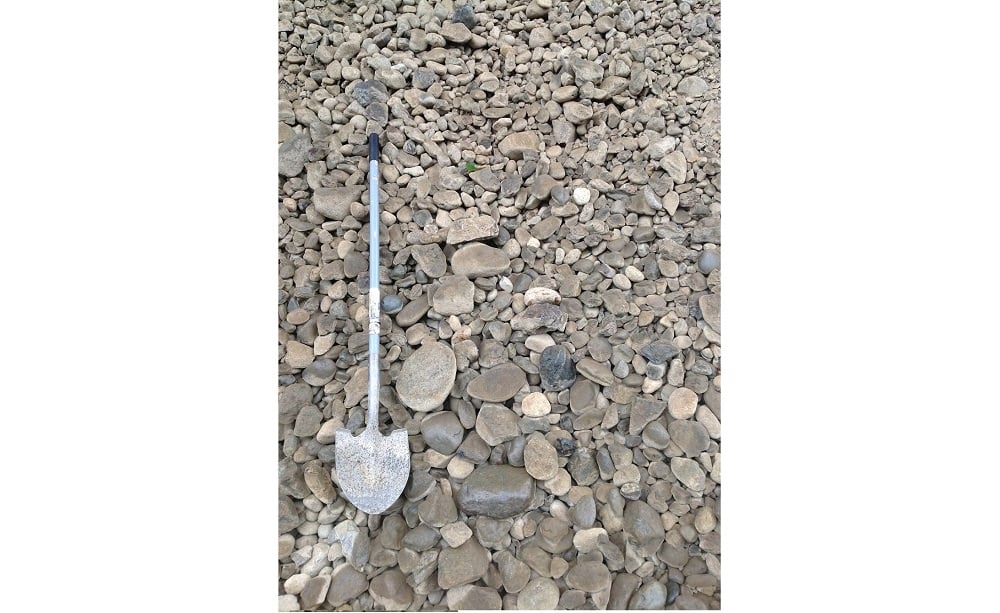
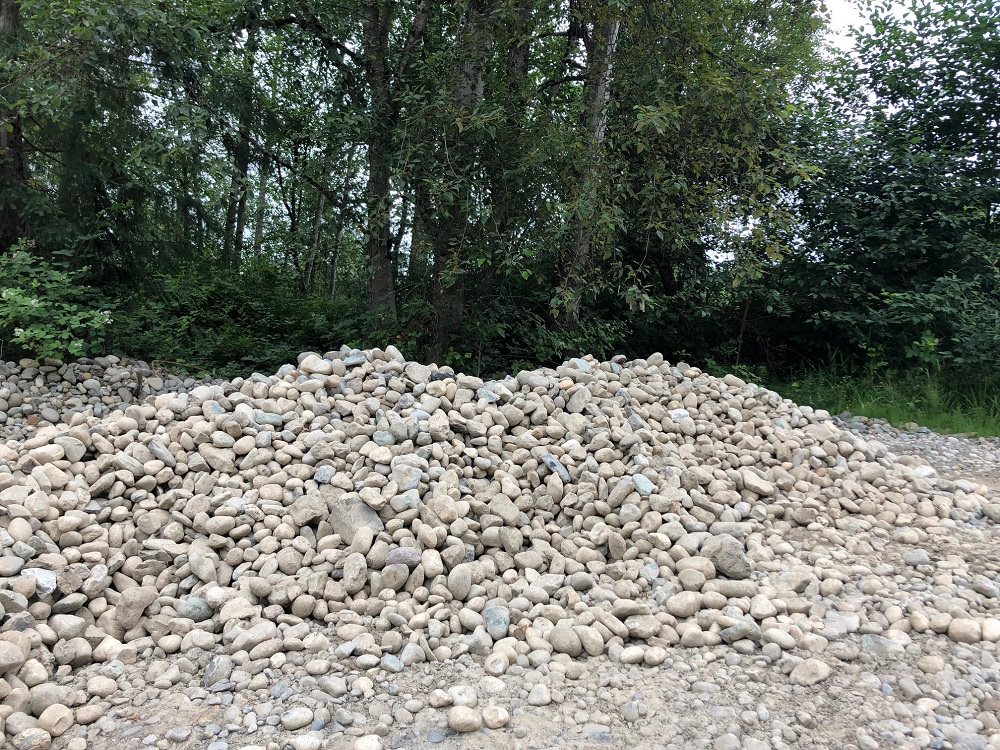
Most rock and building sand suppliers offer extensive sizing options, from pea gravel and utility sand to large rockery rocks. In this article, we’ll be discussing stone options on the larger end of the spectrum: rockery rocks.


What Are Rockery Rocks?


The term “rockery” refers to rock gardens or alpine gardens, which feature decorative stones the size of small boulders. Rockery rocks, then, are the stones used to fill these beautiful and unique garden landscapes. However, rockery rocks can be used in a variety of application beyond decorations. 

Just How Big Are Rockery Rocks?


Generally, rockery rocks refer to boulders about half-man size and up to five man and beyond. For reference, a half man rock might weigh between 10 and 50 pounds, and be eight to 12 inches in size. Some half man rocks can weigh considerably more, depending on their density. The sizes increase quickly from there– rockery rocks that are five man in size might weigh well over a thousand pounds!


While half-man and one-man rocks may be moveable by hand, rocks that are two man or more might require special equipment to maneuver. Ask your quarry or construction service if they offer rock and gravel delivery.


What Are Rockery Rocks Used For?


Though rockery rocks are a favorite decoration for stone gardens, their applications are only limited by the architect’s or landscaper’s creativity. Rockery rocks can be used to build retaining walls or to create stone borders around properties and driveways. Sometimes, rockery rocks are used to build stone steps, benches, and columns. Large stones are also popular in marine applications, such as stone outcroppings for fishing or boat guidance.


Though humble, rockery rocks are incredibly useful for many landscaping projects. By offering stability, beauty, and the sheer impressiveness of their size, they make a great addition to nearly any property, especially since landscaping can increase a home’s resale value by up to 14%. To learn more, give us a call ad Builder Sand and Gravel today!

Landscape Rock Sizes: How to Choose the Right One for Your Project

Written by Builders Sand & Gravel Inc. on . Posted in Blog

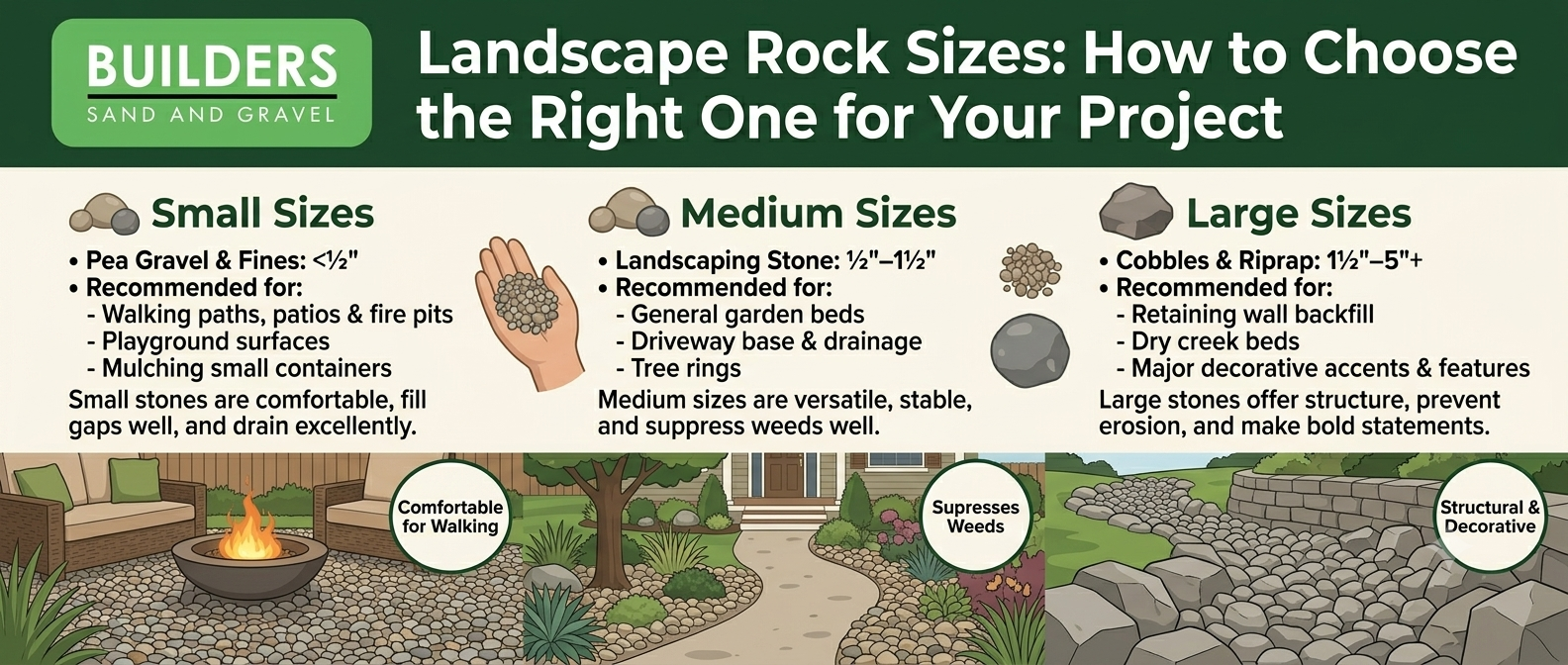
Landscape rock sizes guide comparing small, medium, and large rock for different project uses

Picking landscape rock is less about looks and more about size. The same project can succeed or turn into a maintenance headache depending on whether the stone is too big to rake level or too small to stay put. After years of taking orders, the question we hear most is some version of “what size do I actually need?” Below is how we talk customers through it, from the smallest washed gravel up to boulders that take a machine to place.

Start with the job, not the rock

The fastest way to choose is to picture what the stone has to do. Will people walk on it? Does water need to move through it? (For drainage-heavy projects, Washington’s Department of Ecology Rain Garden Handbook is a helpful reference.) Is it holding soil back, or just dressing up a bed? Foot traffic and drainage push you toward smaller, rounded stone; structure and erosion control push you toward larger, angular rock. Once you know the job, the size almost picks itself.

A quick size guide

Rock sizeRoughlyBest for
Pea gravel3/8 inch, roundedPaths, patios, fire pit surrounds, play areas
5/8 inch minus crushed5/8 inch and smaller, with finesCompacted base for patios, driveways, pavers
3/4 to 2 inch river rock1–2 inches, smoothDecorative beds, borders, dry creek beds
2 to 4 inch quarry spallsBaseball-sized, angularSmall retaining walls, soft-ground stabilization
Boulders / landscape rockHalf-man up to 4–5 manFocal points, large walls, outcroppings
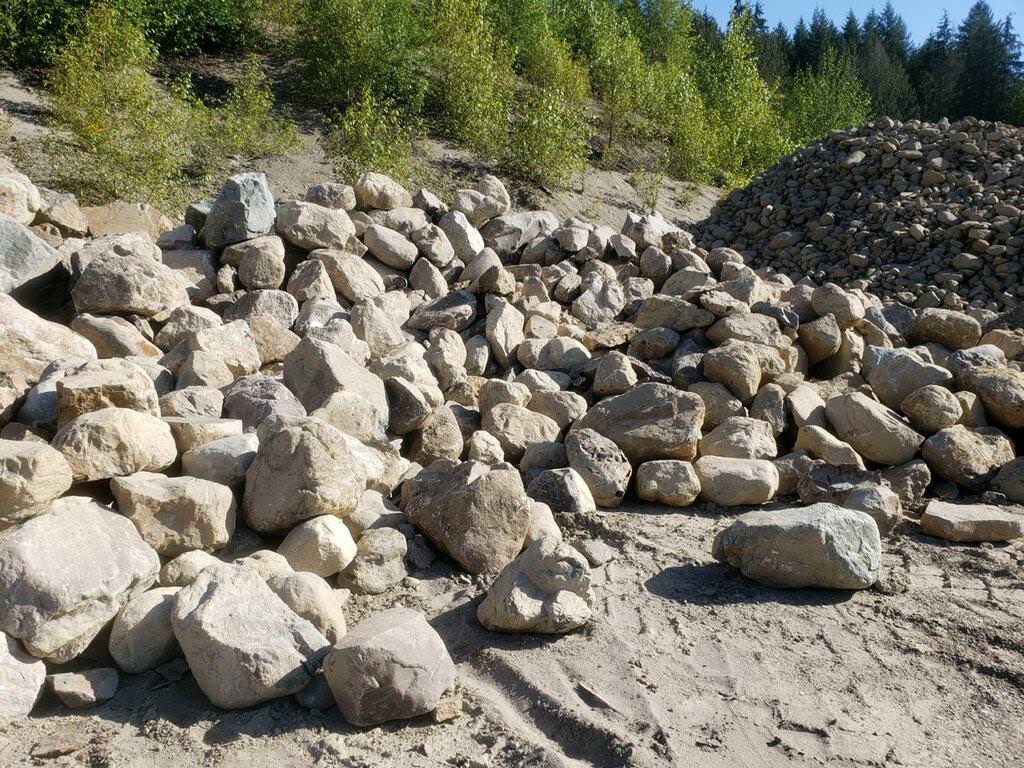
River rock and cobble for decorative landscaping bedsPile of angular quarry spalls used for stability and retaining wallsLarge landscaping boulders and field stones for focal points and walls

Pea gravel (about 3/8 inch)3/8″

This is the small, water-rounded stone people choose when they want a comfortable, walkable surface without pouring concrete. Its rounded edges make it easy on bare feet and simple to rake level, which is why it shows up on patios, garden paths, and around fire pits. Because it stays loose, it needs edging to keep it contained. If a pea gravel project is what you’re planning, we go deep on coverage, cost, and how to install it in our pea gravel guide.

5/8 inch minus crushed gravel5/8″ minus

“Minus” means the load includes the dust and fines along with the stone, and that’s the point — those fines let it compact into a hard, stable surface. The sharper edges lock together under a plate compactor, which makes this the go-to base layer under patios, paver sets, and driveways. It’s a workhorse material rather than a decorative one; you usually don’t see it once the project is finished.

3/4 inch to 2 inch river rock3/4″–2″

River rock is smooth gravel, generally one to two inches across. It’s the decorative middle ground: big enough that it doesn’t scatter the way fine gravel does, smooth enough to look intentional in a bed or along a path. People use it to mulch flowerbeds, line walkways, and build dry creek beds. If you want something that reads as “finished landscaping” without a lot of fuss, this is usually the size.

2 to 4 inch quarry spalls2″–4″

These are the jagged, baseball-sized rocks you reach for when you need stability. They compact reasonably well while still letting water filter through, so they’re common in smaller retaining walls and as a firming layer in wet or soft ground before you build on top. They’re function over form — useful underfoot and behind the scenes rather than as a finish surface.

Large boulders and landscape rockBoulders

At the top end are the boulders, sized anywhere from half-man up to four- or five-man (the old yard shorthand for how many people it would take to move one). These are the centerpieces — focal points in a bed, stone for a larger retaining wall, bench rocks, and outcroppings. They’re heavy enough that placement usually means a machine, so it’s worth planning access before the delivery shows up.

Pro tip

Don’t forget the layers underneath

One thing newcomers miss: most finished rock surfaces are really two sizes working together. A decorative top layer of river rock or pea gravel sits on a compacted base of crushed minus, with landscape fabric in between. The base is what keeps the surface from rutting and sinking, and it’s the step people most often skip. If you’re ordering a decorative stone, ask us whether you also need a base material under it — for patios, paths, and seating areas, you usually do.

Common questions

What’s the most popular size for a backyard path?

Pea gravel for comfort underfoot, or 3/4-to-2-inch river rock if you want something that scatters less and reads more decorative.

Angular or rounded — does it matter?

It does. Angular rock (crushed minus, spalls) locks together and compacts, so it’s for bases and structure. Rounded rock (pea gravel, river rock) stays loose and comfortable, so it’s for surfaces and decoration.

How big is too big?

Once a rock is too heavy to set by hand, you’re into boulder territory and need to plan for equipment and access. For anything you’ll walk on or rake, stay in the gravel-to-river-rock range.

Can I mix sizes?

Yes, and good landscapes usually do — a few larger river rocks scattered through a dry creek bed, or boulders anchoring a bed of smaller stone. Just keep your walking and base layers consistent.

Not sure which size fits your project?

Tell us what you’re building and we’ll point you to the right stone — and the base material to go under it. We deliver landscape rock, river rock, crushed gravel, and boulders across Seattle, Bellevue, Everett, and the Eastside.

Request a Delivery Quote

Drain Rock & Drainage Gravel: What It Is, Sizes & Uses

Written by Builders Sand & Gravel Inc. on . Posted in Blog

drain rock

What Is Drain Rock?

Drain rock is a porous gravel used to control the flow of water. Unlike most stone, it isn’t defined by a single size or shape but by its job: water moves through and around it easily, which makes it the go-to material for drains, foundations, and any spot where standing water causes problems.

You’ll also see it sold as drainage rock, drainage gravel, or drainage stone. These names all describe the same thing. The differences come down to size and whether the rock is washed, not the material itself.

Common Drain Rock Sizes

Drain rock comes in a handful of standard sizes, and the right one depends on the job:

Size Best For
3/8″ (Pea Gravel) Pipe bedding, walkways, and finer drainage where you don’t want large gaps.
3/4″ & 7/8″ Most residential drainage and landscaping work.
1½” The most common size. Drain systems, septic systems, French drains, and river rock in a dry creek bed.

The stone can be smooth or rough depending on where it’s quarried, and color ranges from white to gray-blue to nearly black. For drainage performance, size matters far more than color.

Drain Rock vs. Drainage Gravel vs. Drainage Stone

If you’ve searched these terms and gotten different answers, you’re not alone. In practice they’re interchangeable. “Drain rock” and “drainage gravel” usually refer to the round or angled gravel used in drains, while “drainage stone” is just another regional name for the same product. What actually changes the result is the size you pick and whether it’s washed clean of fines, since leftover sand and dust can clog a drain over time.

How Drain Rock Is Used

  • French drains: A French drain is a trench holding a perforated pipe, packed with drain rock. Water flows through the rock to the pipe and gets carried away, which protects building foundations from water damage. This is the single most common use we deliver for.
  • Driveways: Used beneath and around asphalt or concrete, drain rock absorbs runoff from the pavement. Because topsoil is only a few inches deep and saturates quickly, a drain rock base helps prevent flooding around the driveway.
  • Gardens and landscaping: Gardeners use drainage gravel as a mulch to slow soil erosion, and as a base layer under garden beds so roots don’t stay waterlogged. Larger washed rock also doubles as decorative river rock for dry creek beds and planting-strip borders.

Ordering Drain Rock in the Seattle Area

Not sure how much you need or which size fits your project? That’s worth a quick conversation before you order. We deliver drain rock and washed gravel throughout Seattle, the Eastside, and Snohomish County, and can help you match the size to the job. Contact Builders Sand & Gravel to get started.

4 Tips for Choosing the Best Stone Color for Your Gravel Project

Written by Builders Sand & Gravel Inc. on . Posted in Blog

pea gravelGravel and rock of any kind play important roles in the world of landscaping. From lining pathways to mulching gardens, rock in all shapes and sizes provides both beauty and utility in a variety of applications.


Choosing the perfect stone for your project can be a tricky task. Should you choose small pea gravel, washed gravel, or crushed rock for your pathway? What size should the stone be? What color would look the best?


While size and shape largely come down to practicality, selecting the color of your stone is a matter of personal preference. To choose a stone color you’ll love for years, try using the following guide:


1. Coordinate With Other Elements In the Space


Though pea gravel can be a pretty and charming aspect of your yard, chances are, it’s not the star of the show. When designing a landscape, most homeowners want to show off other lawn elements, like flowers, trees, or yard furniture. Consider these features when choosing a gravel color– if you have a lot of black patio furniture, consider choosing a light stone to contrast the dark. Or, if you already have stone features, pick a similar stone color to help unify your overall landscape.


2. Play With Contrasts and Multicolor


Contrast is a useful tool for calling attention to other yard features. If you have a display of bright white flowers, dark gray, deep brown, or black pea gravel will offset the pale blooms. If you want your gravel pathway to be more visually interesting, you can even order pea gravel in mixed tones and colors.


3. Add Drama with Monochrome


Many designers prefer the bold, stark appearance of saturated monochromes. For example, deep black or nearly white drain rock can create clear borders around flower beds and walkways, which call attention to their shape. If you want a bold, modern look, a single dark or light pea gravel color might be the perfect choice.


4. Consider Temperature


Dark black gravel tends to retain heat, while white rock and utility sand tend to reflect hot temperatures. Consider the amount of sun and shade if your outdoor landscape, and choose colors to help manage temperatures throughout the seasons.


When properly installed, gravel and stone elements can least for years. Even a gravel driveway can last three to five or even 10 years with regular upkeep and maintenance. Use this guide to enjoy the color stone you select for years to come. For more information about gravel and rockery rocks of all kinds in the Seattle area, visit builderssandandgravelinc.com today!